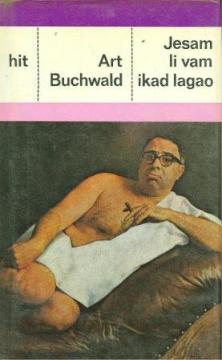
Jesam li vam ikad lagao?

Jesam li vam ikad lagao?

Art Buchwald

Have I Ever Lied to You? by Art Buchwald is a collection of satirical stories and newspaper columns that humorously comment on politics, the media, and everyday life. He uses humor to expose the absurdities of contemporary society.

Have I Ever Lied to You? is a book by American humorist and journalist Art Buchwald, one of the most famous political satirists of the 20th century. The work brings together a series of humorous texts, essays, and columns in which the author comments on political events, social phenomena, and human habits in a recognizable way.

Instead of a single plot and permanent characters, the book consists of a series of independent texts. In them, Buchwald invents seemingly ordinary situations that gradually develop into absurd and comic scenes. He often uses fictional politicians, civil servants, journalists, and citizens in order to ridicule bureaucracy, political propaganda, the excessive seriousness of public life, and numerous social paradoxes through their conversations and actions.

American politics in the 1960s occupies a special place, but the author's remarks transcend specific time and place. His topics include the influence of the media, the relationship of the government to citizens, the consumer mentality, international relations, and everyday human weaknesses. Buchwald does not criticize openly and aggressively, but uses irony, exaggeration and humor to make the reader think.

The characters in his stories often represent types of people – ambitious politicians, confused citizens, bureaucrats or journalists – and serve as a means of depicting broader social problems. This is precisely why humor comes from recognizing real phenomena behind literary caricature.

Thanks to its witty style, short form and sharp observations, Have I Ever Lied to You? remains an interesting work that shows how humor can be an effective means of social criticism and how behind laughter there is often a serious commentary on the world in which we live.

Original title
Have I Ever Lied to You?
Translation
Nikola Kršić
Editor
Zlatko Crnković
Graphics design
Alfred Pal
Dimensions
19.5 x 12 cm
Pages
220
Publisher
Znanje, Zagreb, 1981.
 
Latin alphabet. Hardcover with dust jacket.
Language: Croatian.

Multiple copies are available

Copy number 1

Condition:Used, excellent condition

Copy number 2

Condition:Used, excellent condition
Damages or inconvenience notice:
  • A message of a personal nature

Copy number 3

Condition:Used, excellent condition
 

Are you interested in another book? You can search the offer using our search engine or browse books by category.

You may also be interested in these titles

Zoe

Zoe

Momo Kapor

The novel "Zoe" (1978), one of Momo Kapor's most popular works, follows Arsen Lero, a 39-year-old art historian from the fictional Republic of Kosiliya – a small island under an authoritarian regime.

Znanje, 1978.
Croatian. Latin alphabet. Hardcover with dust jacket.
6.38
Vijetnam

Vijetnam

Marry Mccarthy

Vietnam features Mary McCarthy's travelogues of war-torn Vietnam. The author critically portrays the war, political propaganda, and the dire consequences of the conflict for the civilian population.

Znanje, 1969.
Croatian. Latin alphabet. Hardcover with dust jacket.
8.46
Konačna dijagnoza

Konačna dijagnoza

Arthur Hailey

Arthur Hailey's Final Diagnosis is a medical novel set in a large hospital. Through the fates of doctors and patients, it depicts responsibility, professional errors, and the conflict between tradition and progress in medicine.

Znanje, 1972.
Croatian. Latin alphabet. Hardcover with dust jacket.
4.42
Tijela i duhovi

Tijela i duhovi

Mirko Božić

Bodies and spirits is the third part of the Kurlan trilogy by Mirko Božić, published in 1981, which follows the novels Kurlani (1952) and Neisplakani (1955).

Znanje, 1981.
Croatian. Latin alphabet. Hardcover with dust jacket.
4.98
Prestolonasljednik

Prestolonasljednik

Jaroslav Boček

It is a historical novel that follows the life of Rudolf of Habsburg, later Emperor Rudolf II. The story takes place in the 16th century, during a time of religious and political tensions between Catholicism and Protestantism in the Austro-Hungarian lands

Znanje, 1990.
Croatian. Latin alphabet. Hardcover with dust jacket.
4.98 - 5.38
Zajednička kupka

Zajednička kupka

Ranko Marinković

The communal bath is a kind of recapitulation - in it, Marinković's obsessive motives (humiliation, fraud and death) are discussed in the most direct and immediate way. In one of its layers, the novel is also a metaphor for literature, an allegory about t

Znanje, 1980.
Croatian. Latin alphabet. Hardcover with dust jacket.
8.56