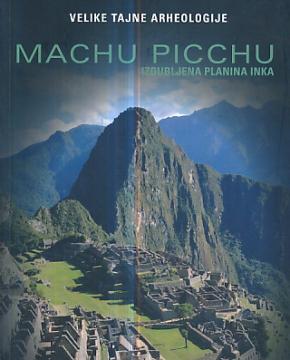
Machu Picchu - Izgubljena planina Inka

Machu Picchu - Izgubljena planina Inka

Francesco Silvestri

Die großen Geheimnisse der Archäologie

Das erste Buch der Reihe „Große Geheimnisse der Archäologie“ ist der berühmtesten Stadt der Inkas gewidmet. Nach der Beschreibung der Stadt selbst bietet das Buch auch ein umfassenderes kulturgeschichtliches Bild derselben, sodass es neben der Entdeckung der Ruinen auch das Leben und die Religion der Inkas und ihrer Dynastie, also der dort lebenden Zivilisationen, zeigt vor ihnen die Ankunft der Konquistadoren und wie Peru heute aussieht. Reichhaltig mit Farbfotos ausgestattet und in einfacher Sprache geschrieben, richtet sich das Buch an alle, die ihr Wissen über die Stadt selbst und die Inka-Kultur erweitern möchten.

Translation
Dialektos d. O. O.
Editor
Cinzia Caiazzo
Dimensions
21 x 17 cm
Pages
175
Publisher
EPH media d. o. o., Zagreb, 2013.
 
Latin alphabet. Paperback.
Language: Croatian.
ISBN
978-9-53338-081-0

One copy is available

Condition:Used, excellent condition
 

Are you interested in another book? You can search the offer using our search engine or browse books by category.

You may also be interested in these titles

Mursa u svjetlu novih izvora i nove literature

Mursa u svjetlu novih izvora i nove literature

Danica Pinterović.

Die wissenschaftliche Studie von Danica Pinterović liefert neue Erkenntnisse über das römische Mursa auf der Grundlage archäologischer Funde und zeitgenössischer Literatur und ergänzt damit das bisherige Wissen über das antike Osijek.

Muzej Slavonije, 1967.
Croatian. Latin alphabet. Paperback.
9.32
Poreklo Slovena: Osvrti na DNK-genealogiju

Poreklo Slovena: Osvrti na DNK-genealogiju

Anatolij A. Kljosov

Anatoly A. Klyosovs Buch „Der Ursprung der Slawen – Ein Blick auf die DNA-Genealogie“ verwendet Methoden der DNA-Genealogie, um die Ursprünge der Slawen, Serben und Russen zu rekonstruieren und stellt damit traditionelle Migrationstheorien des 6. Jahrhund

Miroslav, 2013.
Serbian. Cyrillic alphabet. Hardcover.
34.26
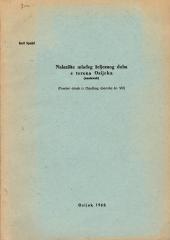
Nalazište mlađeg željeznog doba s terena Osijeka (nastavak)

Nalazište mlađeg željeznog doba s terena Osijeka (nastavak)

Emil Spajić

The study analyzes the Celtic necropolis in Osijek, revealing the simultaneous use of cremation and burial of the deceased. The findings indicate strong Celtic and Illyrian cultural influences and developed metal production.

Muzej Slavonije, 1962.
Croatian. Latin alphabet. Paperback.
11.32
Palača cara Dioklecijana u Splitu

Palača cara Dioklecijana u Splitu

Frane Bulić, Ljubo Karaman

The work of Bulić and Karaman depicts the creation and development of Diocletian's Palace in Split, its historical transformation and significance as a monument of Roman architecture and later an urban center.

Matica hrvatska, 1927.
Croatian. Latin alphabet. Hardcover.
12.46
Vjesnik Hrvatskoga arheološkoga društva, sv III. / 1898

Vjesnik Hrvatskoga arheološkoga društva, sv III. / 1898

Josip Brunšmid, Vjekoslav Klaić, Fran Bulić, Emilij Laszowski, Luka Jelić

The third volume of "Vjesnik" for 1898 contains genealogical and historical contributions on the Croatian nobility, archaeological and epigraphic studies, ethnological and military-topographic sketches, and a report on the work of the historical society.

Hrvatsko arheološko društvo, 1899.
Croatian. Latin alphabet. Hardcover.
32.56
Rasprava o rimskom miljokazu pronađenom kod Osijeka

Rasprava o rimskom miljokazu pronađenom kod Osijeka

Matija Petar Katančić

In his study from 1782, Petar Katančić scientifically examines a Roman milestone found near Osijek (Mursa), making a pioneering contribution to the ancient archaeology of Slavonia and Pannonia.

Muzej Slavonije, 1987.
Croatian. Latin alphabet. Paperback.
14.46