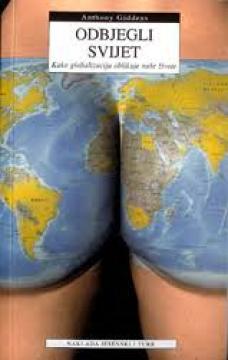
Odbjegli svijet : Kako globalizacija oblikuje naše živote

Odbjegli svijet : Kako globalizacija oblikuje naše živote

Anthony Giddens

This book contains lectures by sociologist Anthony Giddens on the state of the world at the end of the twentieth century. Globalization, risk, tradition, family and democracy are key and unavoidable topics in understanding the state and changes of the mod

The book by the leading British and world sociologist Anthony Giddens deals with the most important aspects and consequences of globalization. Both for nations - states, societies, transnational social formations and political systems, as well as for individuals, families and everyday life.

Borrowing the title of a lecture by anthropologist Edmund Leach from the 1970s, the author refers to a fact that we feel more and more today - namely, the world around us is changing and transforming at a speed that leaves doubts and disorientation... In this popular-scientific introduction to globalization, the author lists all relevant aspects. From economic transnationalization to general risks, identity transformation, various forms of fundamentalism to the restructuring of democratic systems, Giddens covers all the areas in which the expression of globalization is strongest.

Original title
Runaway world
Translation
Ana Milićević
Editor
Tanja Vučković
Dimensions
18 x 12 cm
Pages
107
Publisher
Jesenski i Turk, Zagreb, 2005.
 
Latin alphabet. Paperback.
Language: Croatian.
ISBN
978-9-53222-194-7

One copy is available

Condition:Unused
 

Are you interested in another book? You can search the offer using our search engine or browse books by category.

You may also be interested in these titles

Zaraćeno poraće: Konfliktni i konkurentski narativi o stradanju i iseljavanju Talijana Istre

Zaraćeno poraće: Konfliktni i konkurentski narativi o stradanju i iseljavanju Talijana Istre

Franko Dota

The book analyzes how conflicting historical narratives about the suffering and mass emigration of Italians from Istria and Rijeka developed in Croatia and Italy after World War II (1943–1956), debunking myths and encouraging an empathetic approach to the

Srednja Europa, 2010.
Croatian. Latin alphabet. Paperback.
11.32
Kraj siromaštva: Ekonomske mogućnosti našeg doba

Kraj siromaštva: Ekonomske mogućnosti našeg doba

Jeffrey Sachs

In the book, economist Jeffrey Sachs presents an optimistic plan for eliminating extreme poverty by 2025. He argues that this is feasible with political will, because world wealth is growing, and poverty is not fate, but the result of inefficient systems.

Algoritam, 2007.
Croatian. Latin alphabet. Paperback.
9.78
Rat u transformaciji

Rat u transformaciji

Milan Galović

With the support of scientific and technical discoveries and global economic and media connections, wars have grown into planetary events.

Jesenski i Turk, 2001.
Croatian. Latin alphabet. Paperback.
3.98
McDonaldizacija društva

McDonaldizacija društva

George Ritzer

The book has become a classic because it accurately describes the world of Amazon, Uber, Netflix, and TikTok thirty years in advance. Ritzer does not curse fast food, but warns that if the whole of society turns into McDonald’s, we will remain full but hu

Jesenski i Turk, 1999.
Croatian. Latin alphabet. Paperback.
19.56
Digitalna kultura

Digitalna kultura

Charlie Gere

The existence of digital culture is most often viewed in light of the latest technological advances, giving the impression that it is completely different from everything that preceded it.

Multimedia Clio, 2011.
Serbian. Latin alphabet. Paperback.
16.98
Potčinjenost žena

Potčinjenost žena

Džon Stjuart Mil

King Petar Karađorđević the Liberator, the creator of the state of the Serbs, Croats and Slovenes, based his political program on Milo's treatise On Freedom.

Službeni glasnik, 2008.
Serbian. Latin alphabet. Paperback.
4.42