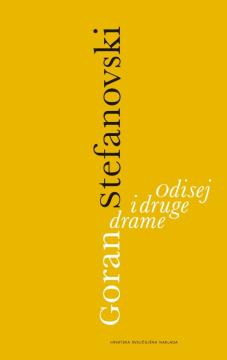
Odisej i druge drame

Odisej i druge drame

Goran Stefanovski

In the selection of four dramatic texts, which is also the first selection of Goran Stefanovski's plays in the Croatian language, an effort was made to cover his decades-long oeuvre.

From his iconic Wild Meat from the end of the seventies, through the Black Hole from the turning point of the eighties and nineties, Demons from Debar Mahala as a scopic drama that reflects the drama of many of our cities today, all the way to Odysseus, which reflects many of "our" nostalgias, traumas and aging over the last twenty or so years, Stefanovski can rightfully be considered one of the most important playwrights. Thematically, he is preoccupied with family, social and moral decay over a wide period of time, the relationship to good and evil, and the resemantization of mythical elements of traditional culture and themes from oral folk literature. Although he is one of the founders of Macedonian postmodernism, his dramaturgy was originally based on modernist principles. His works are characterized by a fast rhythm of scene changes, short lines, concise didascalia, carefully designed dramatic actions, profiled characters, ideological topicality, thematic wealth and a critical attitude towards family, social and national issues. This selection provides an insight into the most significant chapter of Macedonian drama, which is certainly relevant in the Croatian context as well.

Translation
Ivica Baković
Editor
Anita Šikić
Graphics design
Mauricio Ferlin
Dimensions
21 x 13.5 cm
Pages
240
Publisher
Hrvatska sveučilišna naklada, Zagreb, 2018.
 
Latin alphabet. Paperback.
Language: Croatian.
ISBN
978-9-53169-412-4

No copies available

The last copy was sold recently.

 

Are you interested in another book? You can search the offer using our search engine or browse books by category.

You may also be interested in these titles

Drame

Drame

Milutin Cihlar Nehajev

The third volume of Milutin Nehajev's collected works brings together his plays that trace the author's development from youthful enthusiasm to mature introspection: Prielom, Svjećica, Život, Spasitelj and Klupa na mješečini.

Hrvatski izdavalački bibliografski zavod (HIBZ), 1944.
Croatian. Latin alphabet. Hardcover with dust jacket.
6.32
Maskerata

Maskerata

Mihail J. Ljermontov

Lermontov's Masquerade is a powerful romantic drama about jealousy, honor, deceit, and deadly suspicion, set in the elegant world of balls, intrigue, and social masks.

Zora, 1965.
Croatian. Latin alphabet. Hardcover with dust jacket.
5.34
Izabrana djela

Izabrana djela

Marijan Matijašević, Vlado Vlaisavljević

The collection brings together selected works by Marijan Matijašević and Vlado Vlaisavljević, two different but complementary authors. It brings together lyric poetry, short stories, and dramatic texts that connect intimate poetics, social criticism, and

Matica hrvatska, 2004.
Croatian. Latin alphabet. Hardcover.
13.58
Izabrana djela, sv. I.: Dramske slike i poeme

Izabrana djela, sv. I.: Dramske slike i poeme

Aleksandar Sergejevič Puškin

The first volume of Pushkin's selected works brings dramatic images and poems: from scenes from Faust and Mozart and Salieri to The Bronze Horseman and Poltava, combining drama, lyricism and history.

Hrvatski izdavalački bibliografski zavod (HIBZ), 1943.
Croatian. Latin alphabet. Hardcover with dust jacket.
7.42
Euripidove drame: Knjiga druga

Euripidove drame: Knjiga druga

Euripid

The second volume of Euripides' tragedies, translated by Koloman Raca. It contains some of his most famous and powerful plays, in which the author explores the human psyche, passions, and man's conflict with myths and fate.

Matica hrvatska, 1920.
Croatian. Latin alphabet. Paperback.
10.00
Die Räuber

Die Räuber

Friedrich Schiller

"Die Räuber" (1781) is Schiller's first play, a classic example of the Sturm und Drang movement. The play depicts the tragic conflict between two brothers, Karl and Franz Moor, and criticizes corrupt society and tyranny.

dtv Verlagsgesellschaft, 1997.
German. Latin alphabet. Paperback.
3.46