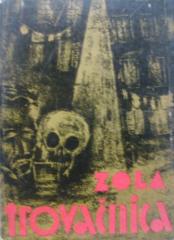

Trbuh Pariza

Trbuh Pariza

Émile Zola

In deep silence, the vegetable cart was going up the deserted wide street towards Paris; the wheels rattled rhythmically and their echo struck the fronts of the houses that fell asleep on either side behind the vague lines of the elms.

At the bridge of Neuillv, bushels of cabbage and bushels of peas joined eight carts of turnips and carrots, coming from Nanterre; the horses walked alone, with their heads down, with a durable and sluggish gait that was slowed down by the uphill. Above, on the load of vegetables, the drivers were dozing with the reins in their hands, stretched out on their stomachs, covered with black and gray striped raincoats. On the way out of the darkness, the gas lamp would illuminate the shoe nails, the blue sleeve of the blouse, the top of the hat, which could be seen among the huge red bundles of carrots, white bundles of turnips, the lush green of peas and cabbage. And on the neighboring roads, the distant clatter of cars announced similar transports; the whole tumult that cut through the darkness and sound sleep at two o'clock in the morning and lulled the black city to the clatter of food as it passed by.

Original title
Le ventre de Paris
Translation
Vjekoslav Zrnc
Editor
Zlatko Gorjan, Jakša Kušan
Graphics design
Valerija Pavić
Dimensions
19.5 x 13.5 cm
Pages
333
Publisher
Matica hrvatska, Zagreb, 1960.
 
Latin alphabet. Hardcover with dust jacket.
Language: Croatian.

Two copies are available

Copy number 1

Condition:Used, excellent condition
Damages or inconvenience notice:
  • Slight damage to the dust jacket

Copy number 2

Condition:Used, very good condition
Damages or inconvenience notice:
  • The cover is missing
 

Are you interested in another book? You can search the offer using our search engine or browse books by category.

You may also be interested in these titles

Zver-čovek

Zver-čovek

Émile Zola

The novel explores the destructive forces of inheritance, passion, and violence in modern industrial society. The action takes place largely on the railroad, a symbol of speed, destiny, and inevitable doom. “Beast Man” is the first description of crime in

Nolit, 1940.
Serbian. Latin alphabet. Paperback with dust jacket.
56.32
Trovačnica

Trovačnica

Émile Zola

The novel The Poisoner was published in sequels during 1876, and in book form in 1877. It is the story of a woman's struggle for happiness in the working class of Paris.

Rad, 1955.
Serbian. Latin alphabet. Hardcover with dust jacket.
8.62 - 9.99
Stranica ljubavi

Stranica ljubavi

Émile Zola
Rad, 1974.
Serbian. Latin alphabet. Hardcover.
5.84
Ulizica

Ulizica

Françoise Sagan
Naprijed, 1987.
Croatian. Latin alphabet. Hardcover.
2.99
Kad čempresi šapuću

Kad čempresi šapuću

Yvette Manessis Corporon

The novel is a moving story of family, love and the discovery of secrets, set on the Greek island of Erikousi. “An unforgettable story about what it truly means to love and be loved…” Maria Menounos

Znanje, 2014.
Croatian. Latin alphabet. Paperback.
3.78
Norwegian Wood

Norwegian Wood

Haruki Murakami

Murakami's famous novel, a nostalgic tale of youth, love and loss, set in 1960s Tokyo, amidst student protests against the Vietnam War. The title comes from a Beatles song, a symbol of lost innocence.

Vintage books, 2003.
English. Latin alphabet. Paperback.
11.26