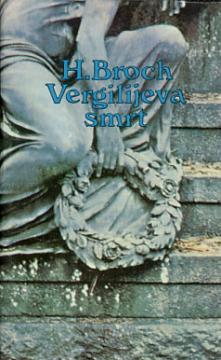
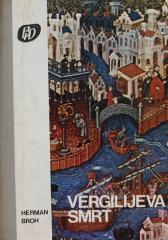
Vergilijeva smrt

Vergilijeva smrt

Hermann Broch

The Death of Virgil (1945) by Hermann Broch, a masterpiece of modern literature, is a philosophical and poetic novel that follows the last 18 hours of the life of the Roman poet Publius Virgil Maron.

Set in Brindisi in 19 BC, the novel explores themes of art, mortality, ethics, and the meaning of existence through Virgil’s inner struggles and visionary meditations.

Virgil, gravely ill, sails to Italy with the emperor Augustus. Faced with his own death, he reexamines his life and work, particularly the Aeneid, which he considers inauthentic because it celebrates empire at the expense of humanity. In feverish musings, he considers the limits of art, its inability to capture truth, and its relationship to power. Virgil wants to destroy the Aeneid, but Augustus persuades him to preserve it, symbolizing the conflict between artist and political power.

The novel is divided into four parts – Water, Fire, Earth, Air – each with a different style, from lyrical to philosophical, reflecting Virgil’s inner transformation. Through encounters with friends, slaves, and visions, Virgil experiences a cosmic journey, coming to terms with the universal interconnectedness of life and death. Broch's complex, polyphonic language and deep philosophical reflections make the novel a meditation on the modern crisis of the spirit, with parallels to 20th-century totalitarianism.

The work, comparable in writing to Joyce and Proust, remains a powerful appeal for the ethical responsibility of the artist and the individual before history.

Original title
Der tod des Vergil
Translation
Truda Stamać
Editor
Milan Mirić
Graphics design
Alfred Pal
Dimensions
21 x 12.5 cm
Pages
445
Publisher
Sveučilišna naklada Liber (SNL), Zagreb, 1979.
 
Latin alphabet. Hardcover with dust jacket.
Language: Croatian.

No copies available

The last copy was sold recently.
 

Are you interested in another book? You can search the offer using our search engine or browse books by category.

You may also be interested in these titles

Vergilijeva smrt

Vergilijeva smrt

Hermann Broch

The Death of Virgil (1945) is Hermann Broch's most famous work. The novel follows the final days of the Roman poet Publius Virgilius Marus, who, gravely ill, travels from Athens to Brundisium, arriving on the birthday of Emperor Augustus in 19 AD.

Svjetlost, 1982.
Croatian. Latin alphabet. Hardcover.
6.99
Šundroman

Šundroman

Bodo Kirchhoff

A thriller is a fun, dynamic book that can be read in one breath, a book that seems to have been created on the model of all those crazy, unforgettable adventure novels that we used to read rather than as reading material. A novel in which the main charac

Fraktura, 2007.
Croatian. Latin alphabet. Paperback.
5.244.19
Hura, još živimo

Hura, još živimo

Johannes M. Simmel

The novel follows the life of Jakob Formann from 1946 to 1976: from a poor returnee from the war, through business ups and downs, love, marriages and scandals, to becoming one of the richest and most famous people in Germany.

Mladost, 1980.
Croatian. Latin alphabet. Hardcover with dust jacket.
6.48
Sanjaj nemogući san

Sanjaj nemogući san

Johannes Mario Simmel

From the bestselling author of "Jimmy and the Rainbow," comes a novel that weaves a love story with the stirring events of the Bosnian war. This story, woven into the historical context, reminds us that sometimes the impossible dream is the only one worth

Mozaik knjiga, 1997.
Croatian. Latin alphabet. Hardcover.
7.42
Proslava mature: Povijest jedne mladenačke krivnje

Proslava mature: Povijest jedne mladenačke krivnje

Franz Werfel

The novel Graduation Celebration by Austrian writer Franz Werfel, published in 1928, is a deeply psychological work that explores themes of guilt, memory, and dealing with the past.

Naklada Binoza, 1935.
Croatian. Latin alphabet. Hardcover with dust jacket.
6.74 - 19.36
Poezija i zbilja

Poezija i zbilja

Johann Wolfgang Goethe

Goethe's greatest autobiographical prose, written between 1811 and 1833, covers his life from his birth in 1749 in Frankfurt to 1775, when he went to Weimar at the invitation of Duke Karl August.

Matica hrvatska, 1953.
Croatian. Latin alphabet. Hardcover with dust jacket.
18.42