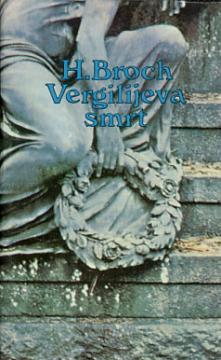
Vergilijeva smrt

Vergilijeva smrt

Hermann Broch

The Death of Virgil (1945) by Hermann Broch, a masterpiece of modern literature, is a philosophical and poetic novel that follows the last 18 hours of the life of the Roman poet Publius Virgil Maron.

Set in Brindisi in 19 BC, the novel explores themes of art, mortality, ethics, and the meaning of existence through Virgil’s inner struggles and visionary meditations.

Virgil, gravely ill, sails to Italy with the emperor Augustus. Faced with his own death, he reexamines his life and work, particularly the Aeneid, which he considers inauthentic because it celebrates empire at the expense of humanity. In feverish musings, he considers the limits of art, its inability to capture truth, and its relationship to power. Virgil wants to destroy the Aeneid, but Augustus persuades him to preserve it, symbolizing the conflict between artist and political power.

The novel is divided into four parts – Water, Fire, Earth, Air – each with a different style, from lyrical to philosophical, reflecting Virgil’s inner transformation. Through encounters with friends, slaves, and visions, Virgil experiences a cosmic journey, coming to terms with the universal interconnectedness of life and death. Broch's complex, polyphonic language and deep philosophical reflections make the novel a meditation on the modern crisis of the spirit, with parallels to 20th-century totalitarianism.

The work, comparable in writing to Joyce and Proust, remains a powerful appeal for the ethical responsibility of the artist and the individual before history.

Naslov izvornika
Der tod des Vergil
Prijevod
Truda Stamać
Urednik
Milan Mirić
Naslovnica
Alfred Pal
Dimenzije
21 x 12,5 cm
Broj strana
445
Nakladnik
Sveučilišna naklada Liber (SNL), Zagreb, 1979.
 
Latinica. Tvrde korice s ovitkom.
Jezik: Hrvatski.

Nema primjeraka u ponudi

Poslednji primjerak je nedavno prodan.
 

Zanima Vas i neka druga knjiga? Možete pretražiti našu ponudu pomoću tražilice ili prelistati knjige po kategorijama.

Možda će Vas zanimati i ovi naslovi

Vergilijeva smrt

Vergilijeva smrt

Hermann Broch

The Death of Virgil (1945) is Hermann Broch's most famous work. The novel follows the final days of the Roman poet Publius Virgilius Marus, who, gravely ill, travels from Athens to Brundisium, arriving on the birthday of Emperor Augustus in 19 AD.

Svjetlost, 1982.
Hrvatski. Latinica. Tvrde korice.
6,99
Prodane djevojke

Prodane djevojke

Hedwig Courths-Mahler

A classic sentimental romance novel with motifs of inheritance, intrigue, class differences and happy love that overcomes obstacles. The main character is the young Rose Rietberg, a beautiful and noble girl who is orphaned at an early age.

Nakladni zavod Matice hrvatske, 1987.
Hrvatski. Latinica. Tvrde korice s ovitkom.
6,98
Hura, još živimo

Hura, još živimo

Johannes M. Simmel

The novel follows the life of Jakob Formann from 1946 to 1976: from a poor returnee from the war, through business ups and downs, love, marriages and scandals, to becoming one of the richest and most famous people in Germany.

Mladost, 1980.
Hrvatski. Latinica. Tvrde korice s ovitkom.
6,48
Dnevnici, 1. svezak: 1909-1912.

Dnevnici, 1. svezak: 1909-1912.

Franz Kafka

Kafka's diaries, published posthumously, reveal the inner world of an anxious genius. The first volume covers his early years, when Kafka worked as an insurance clerk in Prague, faced with a dreary life and literary ambitions.

Tim press, 2022.
Hrvatski. Latinica. Broširano.
15,42
Najljepše priče klasične starine

Najljepše priče klasične starine

Gustav Schwab

Schwab's work restores and develops a sense of the value of antiquity, that inexhaustible source of folk fantasy that seeks to interpret and explain the world with the original poetic power recognized in the traditions of ancient man.

Grafički zavod Hrvatske (GZH), 1989.
Hrvatski. Latinica. Tvrde korice.
Knjiga se sastoji od tri toma
5,254,20
I ne reče ni reči

I ne reče ni reči

Heinrich Böll

In Boll's novels, one of the central themes is the attempt to preserve basic moral values ​​in a time of terror, as well as in a period of material prosperity and corruption.

Svjetlost, 1965.
Srpski. Latinica. Broširano.
3,22 - 3,98