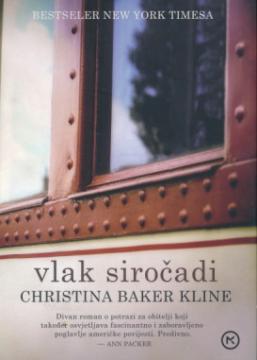
Vlak siročadi

Vlak siročadi

Christina Baker Kline

Orphan Train is a moving novel about the search for family that also shines a light on a forgotten chapter of American history.

Between 1845 and 1929, the so-called orphan trains, which ran regularly from cities on the East Coast to the farming regions of the Midwest, transported hundreds of thousands of abandoned children. Their fate was determined by pure luck. Will they be adopted by a caring family? Or will he face a childhood and adolescence of hard work and service?

As a young Irish immigrant, Vivian Daly was one of those children. She was sent by train from New York to an uncertain future, far from her city. Later back east, Vivian lives a quiet life on the coast of Maine, her memories of growing up hazy. But in her attic, hidden in trunks, lie traces of a turbulent past.

Seventeen-year-old Molly Ayer knows that community service, which she will do by cleaning an old widow's attic, is the only way to escape from the reformatory. But as Molly helps Vivian sort through her memories and possessions, she discovers that she and Vivian aren't as different as they seem. Native American from the Penobscot tribe, who spent her childhood in numerous foster families, Molly is also an outsider raised by strangers. She, like Vivian, has unanswered questions about her past.

Moving from contemporary Maine to Depression-era Minnesota, Orphan Train is a powerful story of upheaval and resilience, second chances and unexpected friendship.

Original title
Orphan train
Translation
Zrinka Budak
Editor
Zoran Maljković
Illustrations
Remy Perthuisot
Graphics design
Eva Vidmar
Dimensions
20 x 14 cm
Pages
298
Publisher
Mozaik knjiga, Zagreb, 2015.
 
Latin alphabet. Paperback.
Language: Croatian.
ISBN
978-9-53141-844-7

No copies available

The last copy was sold recently.


Are you interested in another book? You can search the offer using our search engine or browse books by category.

You may also be interested in these titles

Osuđen na uspjeh

Osuđen na uspjeh

Hans Hellmut Kirst

In this work, the character of police inspector Keller appears for the first time, who fights crime with unusual methods.

Prosveta, 1987.
Croatian. Latin alphabet. Paperback.
4.98
Kreutzerova sonata, Hadži-Murat

Kreutzerova sonata, Hadži-Murat

Lav Nikolajevič Tolstoj

Kreutzer's sonata belongs to those works of Tolstoy that the writer adapted in many ways to his view on moral issues, on marital morality above all.

Civitas, 2004.
Croatian. Latin alphabet. Paperback.
4.98
I ne reče ni reči

I ne reče ni reči

Heinrich Böll

In Boll's novels, one of the central themes is the attempt to preserve basic moral values ​​in a time of terror, as well as in a period of material prosperity and corruption.

Svjetlost, 1965.
Serbian. Latin alphabet. Paperback.
3.22 - 3.98
Strasti i druge pripovijetke

Strasti i druge pripovijetke

Isaac Bashevis Singer

Winner of the Nobel Prize for Literature in 1978, Isaac Bashevis Singer is a prolific writer of novellas and short stories. And in this collection of short stories, the author's penchant for mysticism, grotesque, folklore and eroticism is expressed.

Svjetlost, 1986.
Croatian. Latin alphabet. Hardcover with dust jacket.
6.42
Usta puna zemlje

Usta puna zemlje

Branimir Šćepanović

The novel "Usta puna zemlje" (1970), the masterpiece of the Serbian writer Branimir Šćepanović, is a psychologically in-depth explorer of the limits of the human soul, solitude and existential freedom, reminiscent of Kafka and Camus.

BIGZ, 1987.
Serbian. Latin alphabet. Paperback.
3.98
Proces

Proces

Franz Kafka

Kafka wrote The Process between 1914 and 1915, published posthumously in 1925. The novel is unfinished but with an added final chapter by Max Brod. Edition with a foreword by B. Živojinović and an afterword by Walter Killi.

BIGZ, 1990.
Serbian. Latin alphabet. Paperback.
4.26