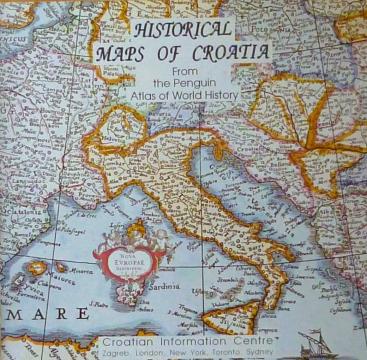
Historical Maps of Croatia
An introduction to Croatian history through maps, illustrations and chronological summaries, with ethnic maps adding a demographic perspective to historical geography.
Historical Maps of Croatia, prepared by an editorial board headed by Ante Beljo, introduces Croatian history through maps, illustrations and chronological summaries. Drawing on material from The Penguin Atlas of World History, it places Croatia within a broader historical and geographical setting.
The combination of mapping and explanatory text helps readers connect events with the places in which they occurred. Chronology establishes a sequence, while maps provide a spatial framework for understanding historical change. This visual approach makes the publication a useful companion for readers who wish to explore the geographical dimensions of history alongside written accounts.
The volume also includes ethnic maps prepared by Miljenko Mikuc, Davor Šterc and Goran Zelić. These add a demographic perspective, bringing population distribution into the discussion of political and historical geography.
Published in English, the book offers an accessible starting point for an international readership interested in Croatia. It can serve as a concise introduction, a companion to broader historical reading or a reference for readers interested in atlases and the visual presentation of the past.
One copy is available