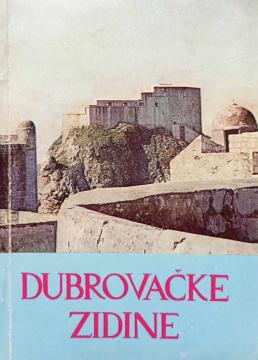
The city walls of Dubrovnik: old, strong and high walls and towers, which surround Dubrovnik from all sides, are among the most massive, beautiful and best preserved in Europe... They are at the same time a great monument to the sacrifices and efforts of
Dimensions
16.5 x 12 cm
Pages
42
Publisher
Društvo prijatelja Dubrovačke starine, Dubrovnik, 1973.
Zdenka Lechner, the first ethnologist at the Museum of Slavonia (1951–1965), made significant contributions to the study of the traditional culture of Slavonia, including the use of pokljuc – earthen lids for baking bread and pastries on the hearth.
Muzej Slavonije, 1962.
Croatian. Latin alphabet. Paperback.
6.32 €
Croatian literature • Facsimile editions • Croatian history
The oldest preserved Croatian primer and a significant monument of Croatian Glagolitic heritage, printed in Venice by Andrija Torresani. Facsimile reprint from 1983, with transliteration and afterword by Josip Bratulić.
Školska knjiga, 1983.
Croatian. Latin alphabet. Paperback.
23.56 €
Education • Pedagogy • Sociology • Croatian history • 20th Century • Collections and chronologies
The collection "Education in the 20th Century", published in 2003 in Annals for the History of Education (vol. 2), contains papers from the professional-scientific meeting in Zagreb (October 25-27, 2001), held on the occasion of the 100th anniversary of t
Hrvatski školski muzej, 2003.
Croatian. Latin alphabet. Paperback.
5.98 €
Sociology • World War II • Croatian history • Yugoslavia • Communism and fascism • 20th Century
The book analyzes how conflicting historical narratives about the suffering and mass emigration of Italians from Istria and Rijeka developed in Croatia and Italy after World War II (1943–1956), debunking myths and encouraging an empathetic approach to the
Srednja Europa, 2010.
Croatian. Latin alphabet. Paperback.
11.32 €
Law • Documents and records • Croatian history • Middle Ages
The collection published on the occasion of the 700th anniversary of the Vinodol Law is one of the most comprehensive editions of the key Croatian legal and cultural heritage. The collection contributes to an in-depth understanding of the Vinodol Law thro