Zona sumraka
A collection of stories by a group of authors: R. Šekli, R. Metison, M. Kasl, B. Balfor, R. Rajzer, Dž. Brenan, Dz. Richie, K. Haudard, M. Faren, P. Sargent, R. Sterling.
No copies available
The last copy was sold recently.

A collection of stories by a group of authors: R. Šekli, R. Metison, M. Kasl, B. Balfor, R. Rajzer, Dž. Brenan, Dz. Richie, K. Haudard, M. Faren, P. Sargent, R. Sterling.
No copies available
The last copy was sold recently.
Are you interested in another book? You can search the offer using our search engine or browse books by category.
The Doom of the World is the first part of Flammarion's vision of the distant future. Through scientific assumptions and philosophical reflections, he depicts the gradual weakening of the Earth and the first signs of the end of human civilization.
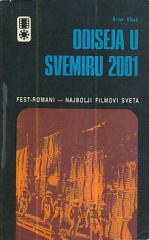
The enigmatic black monolith drives human evolution. Millennia later, the crew of Discovery One and the supercomputer HAL 9000 travel to Saturn to discover the origin of the mysterious signal.
J. B. S. Haldane (1892–1964), a British geneticist, evolutionary biologist, and science popularizer, wrote "My Friend Mr. Leakey" in 1937 – a collection of five humorous, fantastic stories for children (and adults).
Philip Kerr, one of the finest techno-thriller writers, used a near-future setting to present us with the fascinating world of medicine, intertwined within a tense plot.
The motif that Nesvadba has already used in a science fiction context, the FALSIFICATION OF AN ARCHAEOLOGICAL FIND, in "The Showdown with Doctor Dong" serves as a starting point for questioning the RELATIONSHIP BETWEEN REVOLUTION AND SCIENTIFIC TRUTH.
The novel originally titled La Planete des singes, which was the basis for the 1968 film Planet of the Apes.