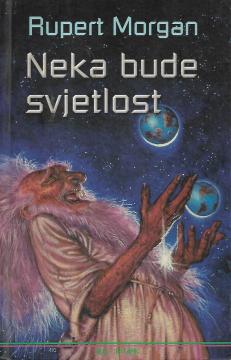
Neka bude svjetlost

Neka bude svjetlost

Rupert Morgan

The British Rupert Morgan claims in this novel that on the other side of the Sun there is a planet identical to Earth and that there live people just like us - only a little crazier. In fact, the people of the United States of Atlantis are totally unhinge

The novel follows the story of a futuristic world where corporations and technology dominate people's lives. The main character is a scientist working on a revolutionary project - the creation of an artificial energy source that could permanently solve the world's energy problems. This "light source" is supposed to bring prosperity to humanity, but soon it is discovered that its consequences are not what they seemed at the beginning.

As the project progresses, the scientist faces moral dilemmas, political pressures, and environmental disasters that result from excessive human greed and disregard for natural limits. Morgan humorously shows how the greed and short-sightedness of the corporate world can threaten the survival of the planet.

Morgan's novel calls for reflection on humanity's responsibility towards nature and technology. In a humorous tone, it sends a serious message about the need for sustainable development and a balance between progress and the preservation of the planet.

Original title
Let There Be Lite
Translation
Kristijan Vlašić
Editor
Neven Antičević
Illustrations
Igor Kordej
Dimensions
24 x 16 cm
Pages
359
Publisher
Algoritam, Zagreb, 2001.
 
Latin alphabet. Hardcover.
Language: Croatian.

No copies available

The last copy was sold recently.
 

Are you interested in another book? You can search the offer using our search engine or browse books by category.

You may also be interested in these titles

Titus Alone

Titus Alone

Mervyn Peake

Titus Alone is a novel written by Mervyn Peake and first published in 1959. It is the third work in the Gormenghast trilogy.

Penguin Books Ltd, 1970.
English. Latin alphabet. Paperback.
3.50
Svijet Atlantide

Svijet Atlantide

A. G. Riddle

Doctor Kate Warner has cured the world of the pandemic, but humanity faces a new threat.

Znanje, 2019.
Croatian. Latin alphabet. Paperback.
6.344.76
Mi

Mi

Jevgenij Zamjatin

Zamyatin's novel "We", written back in 1921, is an expression of the author's disillusionment with socialist ideas and a kind of rebellion against military communism in the USSR.

Izdavački zavod Jugoslavija, 1978.
Serbian. Latin alphabet. Paperback.
8.62
Nevolje sa Tihoom

Nevolje sa Tihoom

Clifford Simak

The novel Nevolje sa Tiho was originally published in 1961 and in a sense marks the end of the first phase of Simak's creativity - namely, the one dominated by the "space opera" tradition.

Dnevnik, 1986.
Serbian. Latin alphabet. Paperback.
4.28
Moj prijatelj gospodin Leakey

Moj prijatelj gospodin Leakey

J. B. S. Haldane

J. B. S. Haldane (1892–1964), a British geneticist, evolutionary biologist, and science popularizer, wrote "My Friend Mr. Leakey" in 1937 – a collection of five humorous, fantastic stories for children (and adults).

Novo pokoljenje, 1950.
Croatian. Latin alphabet. Hardcover.
7.54
Prvi kontakt

Prvi kontakt

Arthur C. Clarke

Zoran Živković, an excellent connoisseur of science fiction, made a selection of Clarke's best stories with the motif of first contact and wrote an extensive text in which he interprets them in detail.

NIRO Književne novine, 1985.
Serbian. Latin alphabet. Paperback.
5.64 - 5.72