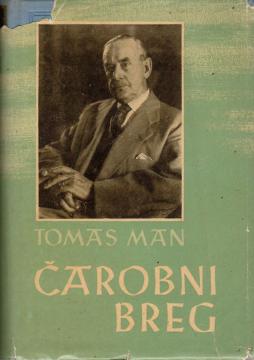

Čarobni breg
Rare book

Čarobni breg

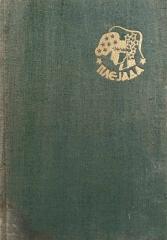
Thomas Mann

"The Magic Mountain" is considered a masterpiece of modernist literature. The novel is rich in symbolism and layers, and its main focus is on the inner development of the protagonist through encounters with different ideas and worldviews.

The book was inspired by Mann's three-week trip to Switzerland to visit his sick wife in a sanatorium in 1912. The first part of the book accurately records Mann's impressions of the place itself and its culture. Like Hans Castorp, the main character, Thomas Mann was diagnosed with a wet spot in his lung towards the end of his visit, but luckily it didn't stay. Mann decided to describe the danger of the mixture of freedom and disease that isolates young people and distracts them from a real and active life. Originally, "Magic Hill" was conceived as a novella the size of "Death in Venice". However, Mann soon realized that the story was taking its own course. The beginning of the First World War forced Mann to suspend work on the novel and reassess his view of European culture. After the war, he reviewed all the material, designing it this time as a critique of the unhealthy and destructive forces swirling around Europe and which in a few years led to the war - the forces he considered solely responsible for the bloody catastrophe. It took him 12 years to finish what he saw as a "serious joke".

The book was immediately recognized by publishers in Germany and quickly became popular in Europe and America. Mann believed that "The Magic Mountain" should be read twice to be fully enjoyed.

Original title
Der Zauberberg
Translation
Miloš Đorđević, Nikola Polovina
Dimensions
20 x 14 cm
Pages
857
Publisher
Prosveta, Beograd, 1954.
 
Latin alphabet. Hardcover with dust jacket.
Language: Serbian.

No copies available

The last copy was sold recently.

 

Are you interested in another book? You can search the offer using our search engine or browse books by category.

You may also be interested in these titles

Smrt u Veneciji

Smrt u Veneciji

Thomas Mann
Jutarnji list, 2004.
Croatian. Latin alphabet. Hardcover with dust jacket.
3.42
Tonio Kröger

Tonio Kröger

Thomas Mann
Zora, 1951.
Croatian. Latin alphabet. Paperback.
4.68
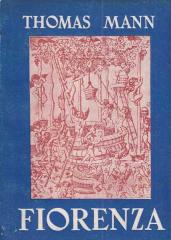
Fiorenza

Fiorenza

Thomas Mann
Zora, 1955.
Croatian. Latin alphabet. Paperback with dust jacket.
6.42
Proces

Proces

Franz Kafka

Kafka wrote The Process between 1914 and 1915, published posthumously in 1925. The novel is unfinished but with an added final chapter by Max Brod. Edition with a foreword by B. Živojinović and an afterword by Walter Killi.

BIGZ, 1990.
Serbian. Latin alphabet. Paperback.
4.26
Deobe 1-3

Deobe 1-3

Dobrica Ćosić

This work, awarded the NIN Prize for that year, is considered one of the most significant in Serbian literature after World War II.

Prosveta, 1961.
Serbian. Cyrillic alphabet. Hardcover with dust jacket.
The book consists of 3 volumes
11.42
Magična ljubavna kutijica

Magična ljubavna kutijica

Santa Montefiore

The Magic Love Box (2002) follows the life story of Federica Campione, which begins in Vina del Mar, Chile, in the summer of 1982. Montefiore creates an epic story of growth, where the magic is not only in the box, but in the courage to let go of the past

Mozaik knjiga, 2006.
Croatian. Latin alphabet. Hardcover.
7.34