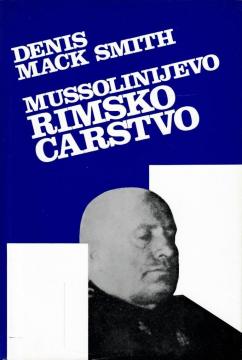
Mussolinijevo rimsko carstvo

Mussolinijevo rimsko carstvo

Denis Mack Smith

The book "Mussolini's Roman Empire" is a detailed analysis of the political ambitions and strategies of Benito Mussolini, with special emphasis on his efforts to restore the glory of the ancient Roman Empire through fascist rule in Italy.

Denis Mack Smith, a historian known for his work on modern Italy, critically examines Mussolini's imperialist aims, domestic politics and international adventures in this book.

The book covers the period of Mussolini's rule, from his rise to power in 1922 to his fall in 1943, focusing on his constant reference to the greatness of the Roman Empire as an inspiration for Fascist Italy. Mack Smith explores Mussolini's attempts to create a modern "Roman Empire" through military and political endeavors.

Mussolini used the symbolism and rhetoric of ancient Rome to legitimize his rule and inspire the Italian people. The main goal was to create Italy as a great world power, competing with Great Britain and France.

Mack Smith details Mussolini's alliance with Nazi Germany and the consequences of that partnership, including Italy's entry into World War II. The author argues that these decisions were driven by Mussolini's desire for personal prestige, rather than a realistic strategy.

"Mussolini's Roman Empire" is a key book for understanding Fascist Italy and Mussolini's failures to create imperial power. Mack Smith offers a brilliant analysis of how ideology, propaganda and political ambition shaped the destiny of Italy in the first half of the 20th century.

Original title
Mussolini’s Roman Empire
Translation
Josip Šentija
Editor
Radovan Vukadinović
Graphics design
Jasna Friščić
Dimensions
24 x 17 cm
Pages
273
Publisher
Globus, Zagreb, 1980.
 
Latin alphabet. Hardcover with dust jacket.
Language: Croatian.

No copies available

The last copy was sold recently.
 

Are you interested in another book? You can search the offer using our search engine or browse books by category.

You may also be interested in these titles

Fašizam i neofašizam

Fašizam i neofašizam

Centar društvenih djelatnosti SSOH, 1976.
Croatian. Latin alphabet. Hardcover.
9.50
Snažan eho brionski: Odjeci Brionskog plenuma u Bosni i Hercegovini 1966. godine

Snažan eho brionski: Odjeci Brionskog plenuma u Bosni i Hercegovini 1966. godine

Amir Duranović

Amir Duranović's book reconstructs in detail the dramatic year 1966 and the Fourth (Brion) Session of the Central Committee of the Communist Party of Yugoslavia (July 1–2, 1966), at which Aleksandar Ranković, the long-time head of the UDB and vice preside

Udruženje za modernu historiju (UMHIS), 2017.
Croatian. Latin alphabet. Paperback.
9.547.15
Ljubljana u borbi 1941–1945: Zbornik sećanja

Ljubljana u borbi 1941–1945: Zbornik sećanja

The collection brings together the memories of participants in the national liberation struggle in Ljubljana during World War II. The collection contains personal testimonies, which provide insight into the everyday life, struggle and sacrifices of the in

Vojnoizdavački zavod, 1978.
Serbian. Latin alphabet. Hardcover with dust jacket.
9.76
Mraz dolazi iz Kremlja

Mraz dolazi iz Kremlja

Zdeněk Mlynář
Globus, 1985.
Croatian. Latin alphabet. Hardcover with dust jacket.
6.32 - 7.16
Kao suza u okeanu I-II

Kao suza u okeanu I-II

Manes Sperber

A trilogy by Austrian-French writer and psychologist Manès Sperber, which, through three novels – "Dust and Ashes", "In the Vortex" and "Memories and Shadows" – explores the themes of totalitarianism, ideological blindness and human suffering during the t

Matica srpska, 1997.
Serbian. Cyrillic alphabet. Paperback.
The book consists of two volumes
9.38
Sudbonosni podvig Jugoslavije: Podsjećanje na historijsko NE staljinizmu, događaj koji je opredijelio budućnost Jugoslavije

Sudbonosni podvig Jugoslavije: Podsjećanje na historijsko NE staljinizmu, događaj koji je opredijelio budućnost Jugoslavije

Raif Dizdarević

The book by Raif Dizdarević, one of the last living actors of Yugoslav diplomacy, presents his reconstruction of the most fateful moment of post-war Yugoslavia – the split with Stalin and the Informburo in 1948–1953.

Udruženje za modernu historiju (UMHIS), 2018.
Croatian. Latin alphabet. Paperback.
23.58