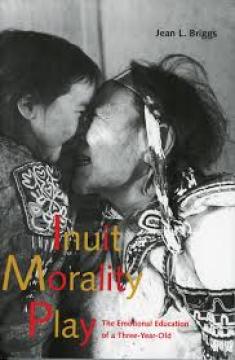
Inuit Morality Play: The Emotional Education of a Three-Year-Old

Inuit Morality Play: The Emotional Education of a Three-Year-Old

Jean L. Briggs

Psychological anthropologist Jean Briggs shows how Inuit adults use dramatic play to transmit cultural messages and moral lessons to their children.

"Is your mother good?" "Are you good?" "Do you want to come live with me?" Inuit adults often playfully present small children with difficult, even dangerous, choices and then dramatize the consequences of the child’s answers. They are enacting in larger-than-life form the plots that drive Inuit social life - testing, acting out problems, entertaining themselves, and, most of all, bringing up their children.

In a riveting narrative, psychological anthropologist Jean L. Briggs takes us through six months of dramatic interactions in the life of Chubby Maata, a three-year-old girl growing up in a Baffin Island hunting camp. The book examines the issues that engaged the child - belonging, possession, love - and shows the process of her growing. Briggs questions the nature of "sharedness" in culture and assumptions about how culture is transmitted. She suggests that both cultural meanings and strong personal commitment to one’s world can be (and perhaps must be) acquired not by straightforwardly learning attitudes, rules, and habits in a dependent mode but by experiencing oneself as an agent engaged in productive conflict in emotionally problematic situations. Briggs finds that dramatic play is an essential force in Inuit social life. It creates and supports values; engenders and manages attachments and conflicts; and teaches and maintains an alert, experimental, constantly testing approach to social relationships.

Dimensions
23 x 15 cm
Pages
275
Publisher
Yale University Press, New York, 1998.
 
Latin alphabet. Paperback.
Language: English.
ISBN
978-0-30008-064-3

No copies available

The last copy was sold recently.
 

Are you interested in another book? You can search the offer using our search engine or browse books by category.

You may also be interested in these titles

Pričanje priča – stvaranje priča

Pričanje priča – stvaranje priča

Vladimira Velički

The aim of this book is to explain the influence of stories and fairy tales on children's lives and to provide concrete incentives for storytelling, both in pedagogical and methodological practice (students, kindergartens, primary schools) and in the fami

Alfa, 2013.
Croatian. Latin alphabet. Hardcover.
9.82
Oprez, opasno po roditelje

Oprez, opasno po roditelje

John Farman

If this manual was published when your moms were teenagers or at least still quite young, it's worth reading.

Mozaik knjiga, 1996.
Croatian. Latin alphabet. Paperback.
6.42
100 pravila odgoja

100 pravila odgoja

Richard Templar

100 pravila odgoja jedinstveni je priručnik pomoću kojega ćete se lakše suočiti sa svim izazovima roditeljstva. Odgojit ćete samopouzdano dijete koje poštuje i suosjeća s drugima, no istodobno se zna zauzeti za sebe i svoja uvjerenja.

Znanje, 2012.
Croatian. Latin alphabet. Paperback.
7.54
Salezijanska škola u Europi

Salezijanska škola u Europi

Knjiga predstavlja znanstveno i pedagoško istraživanje salezijanskog obrazovnog sustava u europskom kontekstu, s posebnim naglaskom na njegovu duhovnu i odgojnu dimenziju.

Salezijanska klasična gimnazija, 1997.
Croatian. Latin alphabet. Paperback.
3.82
Majka uspjeha: kako sam odgojila pobjednike

Majka uspjeha: kako sam odgojila pobjednike

Amy Chua

The author is a law professor at Yale Law School. As a child, she and her family emigrated from the Republic of China to the USA. In this book, he writes about education techniques.

Znanje, 2012.
Croatian. Latin alphabet. Paperback.
7.32
Zašto baš ja: knjiga o nasilju među djecom

Zašto baš ja: knjiga o nasilju među djecom

Hrvoje Kovačević, Gordana Buljan-Flander

Why Me is a book about violence among children, combining a literary and professional approach. It consists of two parts: an artistic part, made up of stories by writer Hrvoje Kovačević, and a professional part, written by psychologist Gordana Buljan-Flan

Znanje, 2005.
Croatian. Latin alphabet. Hardcover.
6.72