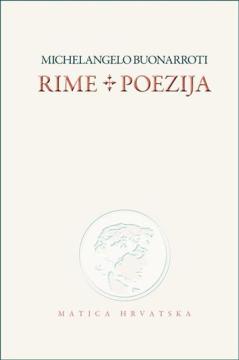
Rime / Poezija

Rime / Poezija

Michelangelo Buonarroti

Although the songs of this artistic genius cannot be compared to his artistic creations, his canconiere composed of 302 songs confirms the author's exceptional artistic and human personality.

The verses that Michelangelo wrote in his free time until his old age leave clear traces of dilettantism, but dilettantism in the best sense of the word: although his poetic expression is neither refined nor finished, and his thought is without deeper insights and "stronger messages", his verses also meet "tragic strength, gloomy melancholy, heroic longing, in short, an undeniable intensity of feeling" and "some violent and strange humor" from which "sometimes deeper and a more serious voice as a sign of a suffering and solitary soul" (Mate Maras).

Michelangelo Buonarroti (1475-1564) was followed during his life by "the unverified voice of thought and the mysterious poet", since his canconiere was published almost sixty years after his death in a bad and arbitrarily edited edition. This is probably the main reason for his marginal place and unconfirmed reputation in Italian literature.

Translation
Mate Maras
Editor
Mate Maras
Graphics design
Luka Gusić
Dimensions
19 x 12 cm
Pages
693
Publisher
Matica hrvatska, Zagreb, 2009.
 
Latin alphabet. Hardcover.
Language: Croatian.
ISBN
978-9-53150-869-8

One copy is available

Condition:Unused
 

Are you interested in another book? You can search the offer using our search engine or browse books by category.

You may also be interested in these titles

Nikome nema povratka

Nikome nema povratka

Alba de Céspedes

No Return (1938) follows the lives of eight young women in a Roman student dormitory, their loves, ambitions, and fates in Italian society before World War II, showing that the past cannot be returned or escaped from itself.

Nakladni zavod Ante Velzek, 1941.
Croatian. Latin alphabet. Hardcover.
The book consists of two volumes
12.42
Hronika o siromašnim ljubavnicima

Hronika o siromašnim ljubavnicima

Vasco Pratolini

In Florence 1925–1926, in the poor Via del Corno, the residents live in love, poverty and fear. The arrival of fascism destroys the community: lovers fight, some die from violence, but popular solidarity survives.

Svjetlost, 1966.
Serbian. Latin alphabet. Paperback.
The book consists of two volumes
4.56
Čočara

Čočara

Alberto Moravia

Widow Cesira and her daughter Rosetta flee bombed Rome to their native Ciociaria, where they experience hunger, fear and misery. Liberation brings tragedy: Rosetta is raped by Moroccan soldiers, destroying their faith in God and people.

Otokar Keršovani, 1966.
Croatian. Latin alphabet. Hardcover.
3.96
Pustolovine u samostanu: priče iz Dekamerona

Pustolovine u samostanu: priče iz Dekamerona

Giovanni Boccaccio

In this humorous and satirical story, Boccaccio depicts life in a monastery and ridicules the hypocrisy and weaknesses of people who should live morally and piously.

Naprijed, 1964.
Croatian. Latin alphabet. Paperback.
3.00
Maskarada / Bračna ljubav

Maskarada / Bračna ljubav

Alberto Moravia

In "Masquerade," Moravia satirically depicts fascist Italy through absurd political intrigue and disguise. "Marital Love" intimately explores erotic tension, possessiveness, and emotional alienation in everyday life.

Minerva, 1959.
Serbian. Latin alphabet. Hardcover.
5.36
Golubovi i jastrebovi

Golubovi i jastrebovi

Grazia Deledda

In a typically Sardinian setting, through a dramatic love story, Deledda depicts the conflict between two families and their worlds – the peaceful, honest "doves" and the aggressive, greedy "hawks".

Hrvatsko književno društvo Sv. Jeronima, 1931.
Croatian. Latin alphabet. Hardcover.
8.54