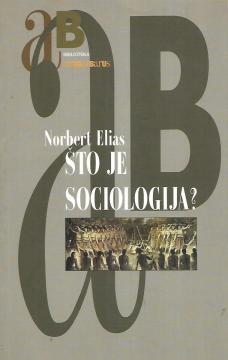
Što je sociologija?

Što je sociologija?

Norbert Elias

A classic work by one of the most influential sociologists of the 20th century, the founder of "figurative" or "process" sociology. The book is a programmatic manifesto against the then dominant structural-functionalist paradigm (Parsons) and pure positiv

Elias elaborates on his key concepts in the book:

  • “figure” (the interdependence of individuals as the basic unit of analysis, not “individual” or “society” as separate instances)
  • “process” – society is not a static state but a long-term, unintentional process (the most famous example: “civilization process”)
  • “social configuration” – a network of interdependencies that shape the behavior of individuals
  • critique of “homo clausus” – the illusion that the individual is a closed box, separated from others

Elias introduces familiar metaphors: society as a dance (four or more people dancing together – there is no dancer without a dance), a game (changing the balance of power changes the rules) and the example of two warring villages that, without intention, create an increasingly complex social structure.

A special chapter is dedicated to “game models” – simple schemes that show how monopolies of power, states and civilizations are born from interdependencies. In the Croatian context, the book has become required reading at universities, as it offers a completely different view of the wars of the 1990s: not as a conflict of "peoples" but as a process of disintegration of long-term interdependencies.

Original title
Was ist Soziologie?
Translation
Srećko Horvat
Editor
Rade Kalanj
Dimensions
24 x 15 cm
Pages
162
Publisher
Antibarbarus, Zagreb, 2007.
 
Latin alphabet. Paperback.
Language: Croatian.
ISBN
978-9-53249-046-6

One copy is available

Condition:Used, excellent condition
 

Are you interested in another book? You can search the offer using our search engine or browse books by category.

You may also be interested in these titles

Istra i njeni razvojni putovi

Istra i njeni razvojni putovi

Juraj Pađen, Stanko Žuljić

The book Istria and its Development Paths from 1973, edited by Juraj Pađen and Stanko Žuljić, is a comprehensive analysis of the economic and social development of Istria in the context of the then Yugoslavia.

Ekonomski institut, 1973.
Croatian. Latin alphabet. Paperback.
7.50
Politika simbola

Politika simbola

Ivan Čolović

The essays collected in this book are inspired by the idea that politics is largely a matter of symbols.

Biblioteka XX vek, 2000.
Serbian. Latin alphabet. Paperback.
9.64
Kultura na društvenoj pozornici

Kultura na društvenoj pozornici

Željko Grbac

Spread and limitations of cultural policy

Grafički zavod Hrvatske (GZH), 1987.
Croatian. Latin alphabet. Paperback.
6.42
McDonaldizacija društva

McDonaldizacija društva

George Ritzer

The book has become a classic because it accurately describes the world of Amazon, Uber, Netflix, and TikTok thirty years in advance. Ritzer does not curse fast food, but warns that if the whole of society turns into McDonald’s, we will remain full but hu

Jesenski i Turk, 1999.
Croatian. Latin alphabet. Paperback.
19.56
Marx u digitalnom dobu: Dijalektički materijalizam na vratima tehnologije

Marx u digitalnom dobu: Dijalektički materijalizam na vratima tehnologije

Katarina Peović-Vuković

The book presents a Marxist analysis of the digital age, where technology is not a neutral tool, but a process subject to the logic of capital. The author advocates a 21st century democratic socialism: technology for needs, not profit.

Durieux, 2016.
Croatian. Latin alphabet. Hardcover with dust jacket.
23.5821.22
Simbolizam i tumačenje

Simbolizam i tumačenje

Tzvetan Todorov

In the book, Todorov examines the relationship between the production of discourse (rhetoric) and its interpretation (hermeneutics), focusing on verbal symbolism – the phenomenon of indirect meaning that builds on direct, literal meaning.

Svetovi, 1986.
Serbian. Latin alphabet. Paperback with dust jacket.
9.54