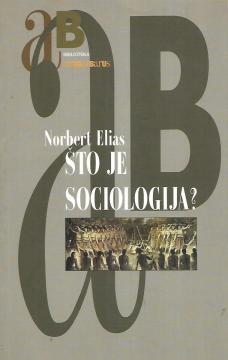
Što je sociologija?

Što je sociologija?

Norbert Elias

A classic work by one of the most influential sociologists of the 20th century, the founder of "figurative" or "process" sociology. The book is a programmatic manifesto against the then dominant structural-functionalist paradigm (Parsons) and pure positiv

Elias elaborates on his key concepts in the book:

  • “figure” (the interdependence of individuals as the basic unit of analysis, not “individual” or “society” as separate instances)
  • “process” – society is not a static state but a long-term, unintentional process (the most famous example: “civilization process”)
  • “social configuration” – a network of interdependencies that shape the behavior of individuals
  • critique of “homo clausus” – the illusion that the individual is a closed box, separated from others

Elias introduces familiar metaphors: society as a dance (four or more people dancing together – there is no dancer without a dance), a game (changing the balance of power changes the rules) and the example of two warring villages that, without intention, create an increasingly complex social structure.

A special chapter is dedicated to “game models” – simple schemes that show how monopolies of power, states and civilizations are born from interdependencies. In the Croatian context, the book has become required reading at universities, as it offers a completely different view of the wars of the 1990s: not as a conflict of "peoples" but as a process of disintegration of long-term interdependencies.

Naslov izvornika
Was ist Soziologie?
Prijevod
Srećko Horvat
Urednik
Rade Kalanj
Dimenzije
24 x 15 cm
Broj strana
162
Nakladnik
Antibarbarus, Zagreb, 2007.
 
Latinica. Broširano.
Jezik: Hrvatski.
ISBN
978-9-53249-046-6

Jedan primjerak je u ponudi

Stanje:Korišteno, u odličnom stanju
Dodano u košaricu!
 

Zanima Vas i neka druga knjiga? Možete pretražiti našu ponudu pomoću tražilice ili prelistati knjige po kategorijama.

Možda će Vas zanimati i ovi naslovi

Zarobljeni um

Zarobljeni um

Czesław Miłosz

The Captive Mind is a book published in France in 1953 by Czesław Miłosz, shortly after he was granted political asylum in Paris due to his conflict with the communist authorities in Poland, which was then under the control of the USSR.

BIGZ, 1987.
Srpski. Latinica. Tvrde korice s ovitkom.
7,28 - 11,48
Dubrovnik grad kulture i umjetnosti

Dubrovnik grad kulture i umjetnosti

Antun Travirka
Forum, 2008.
Hrvatski. Latinica. Broširano.
6,124,59
Vox populi : Zlatna knjiga poslovica svijeta

Vox populi : Zlatna knjiga poslovica svijeta

Tomislav Radić

The book contains over 12,500 proverbs painstakingly collected by Tomislav Radić, a unique collection of wisdom from peoples and nationalities from all over the world. Richly illustrated, this "golden book" remains an invaluable heritage of global folklor

Globus, 1989.
Hrvatski. Latinica. Tvrde korice.
11,00
Najveće kulture svijeta 1: Egipat

Najveće kulture svijeta 1: Egipat

Ania Skliar

The Greatest Cultures of the World is a collection of eight books that talk about the world's great civilizations. The books were first published in Croatia in 2005 in Rijeka by the publisher Extrada d.o.o., but all eight books were also published specifi

Extrade, 2005.
Hrvatski. Latinica. Tvrde korice.
6,32
Ikonosfera

Ikonosfera

Mieczyslaw Porebski
Prosveta, 1978.
Srpski. Latinica. Broširano.
5,50
Najveće kulture svijeta 8: Islam

Najveće kulture svijeta 8: Islam

Miriam Meier

The Greatest Cultures of the World is a collection of eight books that talk about the world's great civilizations. The books were first published in Croatia in 2005 in Rijeka by the publisher Extrada d.o.o., but all eight books were also published specifi

Extrade, 2005.
Hrvatski. Latinica. Tvrde korice.
5,84 - 6,74