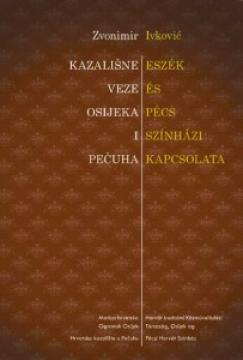
Kazališne veze Osijeka i Pečuha / Eszék és Pécs színházi kapcsolata
Rare book

Kazališne veze Osijeka i Pečuha / Eszék és Pécs színházi kapcsolata

Zvonimir Ivković

The book provides a thorough chronicle and analysis of centuries-old theatrical contacts between two cities – Osijek and Pécs – which historically shared the cultural space of the Pannonian Plain, especially during the period of the Habsburg Monarchy.

Ivković, a prominent Osijek theatre worker and publicist (1944–2010), traces in his introductory study the connections from the 18th century, when travelling theatre companies and German repertoires connected both cities, through the 19th century with the emergence of the Croatian and Hungarian national revivals, to intensive cooperation in the 20th century. Of particular note is the period after World War II, when the Croatian Theatre in Pécs (founded in the 1950s) became the key centre of Croatian culture in Hungary, and cooperation with the Croatian National Theatre in Osijek acquired an institutional character – guest appearances, joint productions, exchange of actors and directors.

The book also includes contributions by other authors, documents, criticism and testimonies about guest appearances (e.g. Šenoa and Krlež in Pécs), and emphasises the role of Pécs as an important centre of Croatian theatre outside the borders of Croatia. Ivković’s analysis shows that these connections were not only artistic, but also identity-based, contributing to the preservation of the Croatian language and culture in the diaspora.

The work is bilingual (Croatian and Hungarian), and serves as a testimony to a long-standing cultural dialogue that transcends political borders. As a "history for the future" (as Branko Hećimović calls it), the book reminds us of the value of regional cooperation and shared cultural heritage.

Translation
Orsolye Gallos, Ivan Kristijan Majić, Mate Zimonyi
Editor
Antonija Bogner-Šaban
Dimensions
21 x 14 cm
Pages
358
Publisher
Matica hrvatska, Osijek, 2012.
 
Latin alphabet. Hardcover.
Language: Croatian.

One copy is available

Condition:Unused
 

Are you interested in another book? You can search the offer using our search engine or browse books by category.

You may also be interested in these titles

Ljubav i sjaj: igrokaz u tri čina

Ljubav i sjaj: igrokaz u tri čina

Hermina Tomić

Love and Splendor (1896) by Hermina Tomić is a three-act play published in the Entertainment Library of the Croatian National Library. The work deals with themes of love, social norms, and moral conflicts in bourgeois society at the end of the 19th centur

Matica hrvatska, 1896.
Croatian. Latin alphabet. Paperback.
7.36
Riječ i maska

Riječ i maska

Borislav Mrkšić
Školska knjiga, 1971.
Croatian. Latin alphabet. Hardcover.
3.76 - 5.24
Kazalište predmeta

Kazalište predmeta

Adam Walny
Šibensko kazalište, 2008.
Croatian. Latin alphabet. Paperback.
5.223.92
Figure i sjene (O žudnji, nasilju i svetom u dramama Jeana Geneta i Bernard-Mariea Koltesa)

Figure i sjene (O žudnji, nasilju i svetom u dramama Jeana Geneta i Bernard-Mariea Koltesa)

Marija Paprašarovski

Marija Paprasharovski's book Figures and Shadows deals with the plays of two prominent French writers, Jean Genet and Bernard-Marie Koltès.

Disput, 2011.
Croatian. Latin alphabet. Paperback.
11.36
Od rituala do medija: mađarska drama na prijelazu tisućljeća

Od rituala do medija: mađarska drama na prijelazu tisućljeća

Peter P. Müller

System change in Hungary in 1989/90. did not change the theater structure, although the publishing structure was significantly transformed.

Matica hrvatska, 2009.
Croatian. Latin alphabet. Paperback.
6.24
Zašto plačeš tata?

Zašto plačeš tata?

Ivica Ivanac

It is a work that deals with difficult post-war themes, personal tragedies, emotional wounds, and relationships within the family, especially between fathers and children.

Zagrebačko dramsko kazalište, 1960.
Croatian. Latin alphabet. Paperback.
2.98