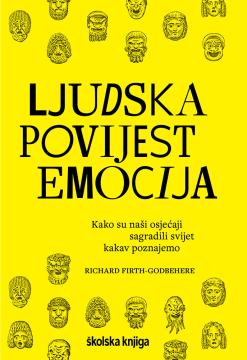
Ljudska povijest emocija: Kako su naši osjećaji sagradili svijet kakav poznajemo

Ljudska povijest emocija: Kako su naši osjećaji sagradili svijet kakav poznajemo

Richard Firth-Godbehere

In this provocative and interdisciplinary book, the author shows that emotions are not universal biological constants, but change across time, cultures, and social contexts – and they are precisely those that are crucial in shaping the history of humanity

People like to think they are rational beings who survived thanks to reason and calculation. But the author argues the opposite: the most important historical moments - from the birth of philosophy and the great religions, to the fall of the Roman Empire, the Scientific Revolution, to the bloodiest wars - were driven by feelings, not just cold facts.

The book takes the reader on a wide journey through history and different cultures: from ancient Greece (where "melancholia" was a humoral imbalance, not depression), through India, Gambia, Japan, the Ottoman Empire, to the modern United States. The author draws from psychology, neuroscience, philosophy, art, and religious history to show how the understanding and experience of emotions has changed - from the "passions of the soul" in the Middle Ages, through "emotions" as a modern concept in the 19th century, to today's emotional "regimes" and "scripts".

Emotions are social constructs that influence laws, wars, art, religion, and everyday life. The book shows how fear, shame, anger, love, or disgust have shaped social norms, empires, and revolutions. Firth-Godbehere emphasizes that our feelings and beliefs about them have actively shaped the world—and continue to shape it today.

This is an accessible yet profound synthesis of the growing discipline of "the history of emotions," which forces us to question how much of our feelings are "natural" and how much is culturally conditioned. Ultimately, the book reveals how much of human history is actually the history of the heart, not just the mind.

Original title
A Human History of Emotion: How the Way We Feel Built the World We Know
Translation
Vedran Pavlić
Illustrations
Arthur Balitskii
Graphics design
Juliana Misumi
Dimensions
24 x 16 cm
Pages
303
Publisher
Školska knjiga, Zagreb, 2023.
 
Latin alphabet. Hardcover with dust jacket.
Language: Croatian.

One copy is available

Condition:Unused
 

Are you interested in another book? You can search the offer using our search engine or browse books by category.

You may also be interested in these titles

Plan B: Pioniri borbe s klimatskom krizom i budućnost mobilnosti

Plan B: Pioniri borbe s klimatskom krizom i budućnost mobilnosti

Boštjan Videmšek
Naklada Ljevak, 2023.
Croatian. Latin alphabet. Paperback.
18.26
Stiegler and Technics

Stiegler and Technics

Christina Howells, Gerald Moore, Christopher Johnson, Michael Lewis, Ian James, Serge Trottein, P...
Edinburgh University Press, 2013.
English. Latin alphabet. Paperback.
13.24
Pravo na laganje

Pravo na laganje

Kant argued that there is no right to lie because telling the truth is an absolute duty, while Constant advocated the possibility of an exception to the duty, arguing that one should lie for the common good, which sparked a famous philosophical debate.

Službeni glasnik, 2008.
Serbian. Latin alphabet. Paperback.
8.36
Logos i apsurd

Logos i apsurd

Daniel Bučan

"Logos and Absurd" is a collection of seven philosophical studies by Croatian philosopher Daniel Bučan, in which the author explores the ontological meaning of logos – words, reason, and order – in contrast to absurdity as a tragic experience of life.

ArTresor naklada, 2024.
Croatian. Latin alphabet. Paperback.
13.24
Iz istarske spomeničke baštine

Iz istarske spomeničke baštine

Branko Fučić
Matica hrvatska, 2006.
Croatian. Latin alphabet. Hardcover with dust jacket.
The book consists of two volumes
39.99
Filozofija i smrt

Filozofija i smrt

Maja Milčinski

This work, along with various themes and problems of the Asian philosophical and religious schools, tries to show the acceptance of death as a part of life. The tradition of a cultivated relationship with death acts as a medicine and enables a positive re

CID-NOVA, 2008.
Croatian. Latin alphabet. Paperback.
7.42