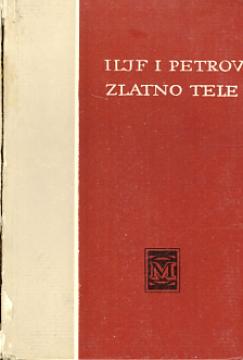
Zlatno tele

Zlatno tele

Iljf i Petrov

The Golden Calf (1931) is a brilliant satirical picaresque adventure, a sequel to the legendary 12 Chairs, where the great schemer Ostap Bender returns in full glory – charming, cynical, irredeemably cunning and always one step ahead of everyone else.

The story takes place in the Soviet Union in the late 1920s, during the NEP and the beginning of the five-year plan, when old Russia was mixing with new socialist dreams. Ostap Bender, who survived in the first novel (although he did not receive millions), now sets his sights on a new target: the secret treasury of businessman Alexander Koreiko, one of the rare Soviet millionaires who made his fortune through smuggling, bribery and manipulation, and lives modestly as an ordinary accountant. Bender gathers a team of "lieutenant's sons" - a motley crew of swindlers, dreamers and opportunists - and sets off on a grand chase across the entire USSR: from Moscow, through Kharkov, over the railways, to the Black Sea and Central Asia. The novel is full of hilarious episodes: fake film footage, the "Antelope-Gnu" car that becomes a legend, encounters with bureaucrats, journalists, the police and ordinary people. Bender excels with his aphorisms ("Don't bother, I'll tell you the truth - I'm a great schemer!", "The rich are poor people"), ridiculing the corruption, bureaucracy, greed and hypocrisy of the new society. But beneath the humor lies a bitter note: Ostap is a tragic character - a brilliant swindler who dreams of "Rio de Janeiro" (a symbol of freedom and wealth), but realizes that there is no place for an individual like him in the Soviet Union. Ilf and Petrov write quickly, humorously, with Odessa charm and a sharp eye for the absurd - the novel is full of quotes that have entered the language ("How is life on the Riva?", "Your telegram received, but not understood"). It is a satire on Soviet reality, but also a universal comedy about human greed and illusions.

Translation
Stjepan Kranjčević
Editor
Milorad Stojović
Dimensions
17 x 12 cm
Pages
475
Publisher
Grafički zavod - Titograd, Podgorica, 1964.
 
Latin alphabet. Hardcover.
Language: Croatian.

One copy is available

Condition:Used, excellent condition
Damages or inconvenience notice:
  • Traces of patina
  • Slight damage to the cover
 

Are you interested in another book? You can search the offer using our search engine or browse books by category.

You may also be interested in these titles

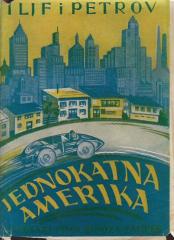
Prizemna Amerika

Prizemna Amerika

Iljf i Petrov

At the end of 1935, the famous Russian writing duo set off on a car trip across the United States, where they spent a total of three and a half months.

Grafički zavod Hrvatske (GZH), 1964.
Croatian. Latin alphabet. Hardcover.
9.19 - 9.97
Andrićeva lestvica užasa

Andrićeva lestvica užasa

Svetislav Basara

A Serbian writer known for his satirical novels, Andrić's Ladder of Horrors dissects the Balkan mentality through a parable of Yugo-nostalgia and national myths. The title alludes to Ivo Andrić as a litmus test for criticism – Balkans claim him or reject

24 sata, 2021.
Serbian. Latin alphabet. Paperback.
11.56
Proces

Proces

Franz Kafka

Kafka wrote The Process between 1914 and 1915, published posthumously in 1925. The novel is unfinished but with an added final chapter by Max Brod. Edition with a foreword by B. Živojinović and an afterword by Walter Killi.

BIGZ, 1990.
Serbian. Latin alphabet. Paperback.
4.26
Aurorin poticaj

Aurorin poticaj

Erich Hackl

The work is based on a true event that occurred in Spain in 1933: Aurora Rodriguez killed her daughter Hildegart, a famous fighter for women's emancipation and a cult figure on the political scene of the time.

Mladost, 1990.
Croatian. Latin alphabet. Hardcover with dust jacket.
4.96 - 4.98
Zagrepčanka

Zagrepčanka

Branislav Glumac

Branislav Glumac veröffentlichte 1974 einen Roman ohne Punkte und Kommas, den unerbittlichen Gedankenstrom eines jungen Rebellen. Das im sozialistischen Jugoslawien erschienene Werk löste mit seiner Offenheit einen Skandal aus und wurde zu einem Klassiker

IROS, 1986.
Croatian. Latin alphabet. Hardcover.
8.24
Kreutzerova sonata, Hadži-Murat

Kreutzerova sonata, Hadži-Murat

Lav Nikolajevič Tolstoj

Kreutzers Sonate gehört zu jenen Werken Tolstois, die der Schriftsteller in vielerlei Hinsicht seiner Ansicht über moralische Fragen, vor allem über die eheliche Moral, anpasste.

Civitas, 2004.
Croatian. Latin alphabet. Paperback.
4.98