Hrvatski karusel
In the book, Šuvar collects his discussions and comments on the Croatian political and social reality from 1990 to 2003. He critically dissects nationalism, the transition to capitalism, and the role of the elite, warning of the long-term consequences for
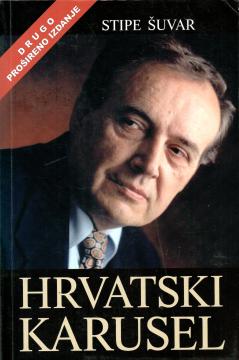
Stipe Šuvar (1936–2004), a long-time sociologist, politician and former high-ranking official of the League of Communists of Yugoslavia, in his book "Croatian Carousel: Contributions to the Political Sociology of Croatian Society" (first edition 2003, second expanded edition 2004) brings together a selection of his texts – discussions, commentaries, interviews and analyses – written in the period from the early 1990s to 2003. It is his last major publicistic work, written at a time when he was already marginalized in the Croatian public due to his leftist and Yugoslav beliefs.
The title "carousel" metaphorically describes the dizzying, meaningless circle of Croatian politics and society after the breakup of Yugoslavia: from the euphoria of national independence, through war and ethnic conflicts, to the transition to capitalism accompanied by corruption, privatization plunder and social stratification. Šuvar writes about how nationalism became the dominant ideology, how the elites enriched themselves at the expense of the majority, how the mass emigration of Serbs occurred (which he calls ethnic cleansing), about the "cleansing" of language and culture from "Serbo-communist" elements, about the collapse of the socialist heritage, and about how the new government continued authoritarian practices under a different name.
The book is divided into 11 thematic sections that cover key issues: from the Serbian question in Croatia, through the role of the Catholic Church and the nationalist elite, to criticism of the HDZ regime, media manipulation, economic devastation, and the perspectives of the left. The section on demographic changes and the disappearance of Serbs from Croatia is particularly powerful – Šuvar uses censuses and historical data to show the continuity and dramatic decline in the number of Serbs, accusing politics of systematic emigration and expulsion.
The style is sharp, polemical, often sarcastic – Šuvar spares no one: neither the Tuđman regime, nor the opposition, nor the church, nor the international community. He writes from the position of a consistent leftist and Yugoslav who sees the collapse of Yugoslavia as a tragedy, and the Croatian transition primarily as class plunder and nationalist hysteria. The book caused controversy – for some it was "treasonous" and "Yugonostalgic", for others a brave voice against the mainstream.
It is still read today as an important document of critical sociology of the 1990s and early 2000s: it shows how old power structures were transformed into new ones, how nationalism served as a smokescreen for economic plunder, and why Croatia, despite independence, remained trapped in a cycle of corruption, inequality and identity conflicts. This is Šuvar's last great contribution – a testament of the "last Croatian Yugoslav" who warned of the price society pays for the nationalist "carousel".
One copy is available