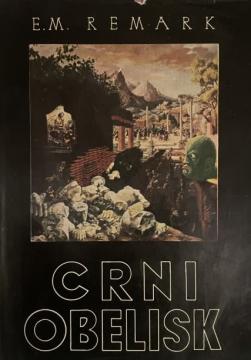

Crni obelisk

Crni obelisk

Erich Maria Remarque

Through a series of episodes, the novel depicts everyday life in the age of inflation, love relationships, political tensions and a growing sense of hopelessness, but also irony and humor as a way of survival.

Erich Maria Remarque's novel is set in Germany in the early 1920s, during a period of hyperinflation and social instability after World War I. The main character, Ludwig Bodmer, works in a stonemason's workshop selling tombstones – a job that symbolically reflects the spirit of the times marked by death, loss and moral decay. Ludwig tries to find meaning in life in a world that is falling apart: money is rapidly losing value, people are doing what they know how, and the lines between honesty and fraud are becoming blurred. In addition to his work, Ludwig plays the organ and conducts internal philosophical monologues about life, love and the absurdity of existence. An important role is played by Isabelle, a young woman in a psychiatric institution, with whom Ludwig develops a special relationship. Their relationship raises questions about reality and illusion, reason and madness. Isabelle often seems “crazy”, but her words sometimes reveal deeper truths than those accepted by “normal” society.

Original title
Der schwarze obelisk
Translation
Boško Petrović
Editor
Risto Trifković
Dimensions
20 x 14.5 cm
Pages
358
Publisher
Narodna prosvjeta, Sarajevo, 1957.
 
Latin alphabet. Hardcover with dust jacket.
Language: Croatian.

One copy is available

Condition:Used, very good condition
Damages or inconvenience notice:
  • The cover is missing
 

Are you interested in another book? You can search the offer using our search engine or browse books by category.

You may also be interested in these titles

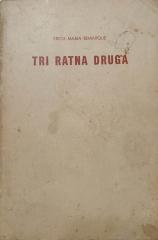
Tri ratna druga

Tri ratna druga

Erich Maria Remarque

Three World War I comrades—Robbie, Otto, and Gottfried—try to survive in Weimar Germany in 1928. Amid economic crisis, poverty, and political violence, their friendship is their only refuge.

Minerva, 1953.
Serbian. Latin alphabet. Paperback.
1.99
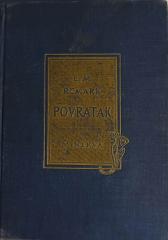
Povratak

Povratak

Erich Maria Remarque
Minerva, 1955.
Croatian. Latin alphabet. Hardcover.
1.62 - 1.98
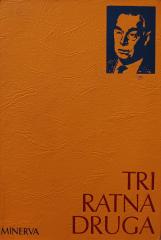
Tri ratna druga

Tri ratna druga

Erich Maria Remarque

Three World War I comrades—Robbie, Otto, and Gottfried—try to survive in Weimar Germany in 1928. Amid economic crisis, poverty, and political violence, their friendship is their only refuge.

Minerva, 1978.
Serbian. Latin alphabet. Hardcover.
3.99 - 8.98
Ljubičice u srijedu

Ljubičice u srijedu

Andre Maurois

André Maurois, a French writer known for his psychological novels and biographies, explores themes of family relationships, love, and internal conflicts in this work, which is characteristic of his style.

Svjetlost, 1965.
Croatian. Latin alphabet. Paperback.
3.42 - 3.62
V.

V.

Thomas Pynchon

The novel represents a journey into an alternative world – a world that we all belong to from time to time, but of which we would not want to be a part, a world of paranoia and alienation that we are not entirely sure is just an alternative or the bare tr

Čarobna knjiga, 2010.
Serbian. Latin alphabet. Paperback.
21.98
Deobe 1-3

Deobe 1-3

Dobrica Ćosić

This work, awarded the NIN Prize for that year, is considered one of the most significant in Serbian literature after World War II.

Prosveta, 1961.
Serbian. Cyrillic alphabet. Hardcover with dust jacket.
The book consists of 3 volumes
11.42