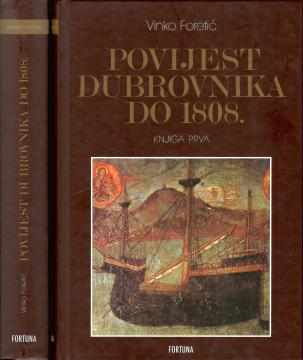
Povijest Dubrovnika do 1808.
The development of Dubrovnik from the Middle Ages to the abolition of the Republic, through politics, society and trade. Reprint of the first edition from 1980, which has an index of authors, which the first edition did not contain.
Vinko Foretić's two-volume work The History of Dubrovnik until 1808 presents the chronological and thematic development of the Dubrovnik Republic from its early medieval beginnings to the final extinction of statehood by becoming part of Napoleon's government. The author connects political history with the economic, cultural and social processes that shaped the unique identity of the city-state.
In the early centuries, Dubrovnik formed as a commercial and maritime center between East and West, gradually gaining autonomy within the conflict of Byzantine, Venetian and Hungarian-Croatian influences. Foretić analyzes how diplomatic skill, trade and the ability to balance between great powers enabled the Republic to achieve relative stability and growth, especially during the late Middle Ages and early modern times.
In the 15th and 16th centuries, Dubrovnik reached its economic and cultural peak. The educated patrician class developed a sophisticated system of administration, and merchants expanded their networks throughout the Balkans, the Levant and the Mediterranean. Foretić emphasizes the role of shipping, diplomacy, and trade privileges, as well as the relationship with the Ottoman Empire, whose protection was crucial for the Republic's survival. The catastrophic earthquake of 1667 marks a turning point, followed by a long period of recovery, institutional reorganization, and economic decline.
The author pays special attention to the social structure: patricians, commoners, Konavle serfs, and the everyday life of the city. He also depicts the long-term struggle between the closed nobility and the growing commoner classes, as well as attempts to modernize the administration in the 18th century. Foretić concludes the account with the collapse of the Republic in 1808, when the French government abolished the centuries-old order, thus ending one of the longest-lasting European political systems.
The book consists of two volumes.
Jedan višetomni primjerak je u ponudi.