Hromi djavo
Rare book
Antique

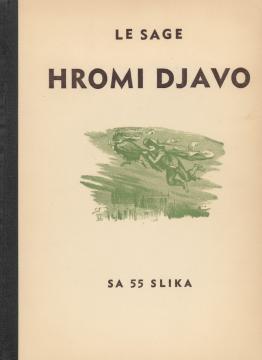
Hromi djavo

Alain-René Le Sage

The Lame Devil (1891) is an abridged and illustrated edition of Alain-René Le Sage's famous novel, adapted for young people. Through a fantastic adventure, it offers a satirical portrayal of human flaws and social conditions.

The Lame Devil by the French writer Alain-René Le Sage is one of the most famous satirical works of European literature. The Croatian edition was published in Senj in 1891 as an abridged edition for young people with 55 pictures, adapted for younger readers. The translation is not made directly from the original text, but from the French edition of the Bibliothèque de l'École et de la Famille, one of the most influential European libraries for young people of the 19th century.

The plot follows the student Don Cleofas who frees the demon Asmodeus, the lame devil. In gratitude, the demon takes him above the city rooftops and allows him to peek into the hidden lives of people. Through a series of episodes, human weaknesses, ambitions, deceptions and social injustices are revealed, so the fantastic adventure becomes a witty and sharp satire of human society.

The special value of the Senj edition is its rich illustrative equipment. The book contains 55 illustrations taken from a French model, and the author of the drawings was Tony Johannot (1803–1852), one of the most famous French illustrators of Romanticism. Johannot's illustrations, originally published in the Paris editions of Le Sage's works, significantly contributed to the novel's popularity among young readers and represent an important example of 19th-century European book illustration.

The Senj edition testifies to the efforts of Croatian publishers to bring the classics of European literature closer to the domestic audience in an accessible and visually appealing form. Today it represents a valuable example of an illustrated youth book and an interesting blend of Croatian publishing tradition and French literary culture of the late 19th century.

Original title
Le Diable boiteux
Translation
Milan Gruber
Illustrations
Tony Johannot
Dimensions
21 x 13.5 cm
Pages
154
Publisher
Naklada H. Lustera, Senj, 1891.
 
Latin alphabet. Hardcover.
Language: Croatian.

One copy is available

The copy was subsequently bound, and the cover is in quite poor condition, which is why its price has been significantly reduced.
Condition:Used, condition good enough
Specificity of this instance:
Bound
Damages or inconvenience notice:
  • Damaged covers
  • Traces of patina
 

Are you interested in another book? You can search the offer using our search engine or browse books by category.

You may also be interested in these titles

Tri mušketira 1-2

Tri mušketira 1-2

Alexandre Dumas

Dumas' version of the story depicts the adventures of d'Artagnan and his friends from 1625 to 1628.

Epoha, 1966.
Croatian. Latin alphabet. Hardcover with dust jacket.
The book consists of two volumes
9.48
Robin Hood

Robin Hood

Alexandre Dumas

Dumas portrays Robin Hood not only as a bandit who helps the poor, but also as a heroic fighter for justice and a symbol of resistance to feudal injustice.

Epoha, 1966.
Croatian. Latin alphabet. Hardcover with dust jacket.
4.26 - 4.82
Talijanske kronike

Talijanske kronike

Marie-Henry Beyle Stendhal

Flipping through old Italian chronicles, Stendhal finds motifs for a series of his novels in which he depicts the passions of the Middle Ages and the unrestrained madness of the Renaissance.

Matica hrvatska, 1948.
Croatian. Latin alphabet. Hardcover with dust jacket.
9.36
Gustave Flaubert

Gustave Flaubert

Émile Zola
Nakladni zavod Hrvatske, 1948.
Croatian. Latin alphabet. Paperback.
3.76
Posada

Posada

Joseph Kessel

The novel is considered one of Kessel's most significant works, inspired by his experiences as a pilot during World War I.

Minerva, 1987.
Serbian. Latin alphabet. Hardcover.
4.38
Evgenija Grande / Muzej starina

Evgenija Grande / Muzej starina

Honore de Balzac

In his novels Eugenie Grandet (1833) and The Museum of Antiquities (1837), Balzac explores universal themes of greed, human passions, sacrifice, and moral dilemmas, placing them in different social contexts of 19th-century French society.

Svjetlost, 1963.
Croatian. Latin alphabet. Hardcover.
3.48