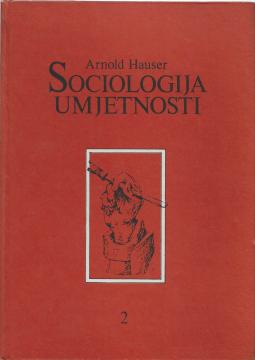
Sociologija umjetnosti 2. dio
Along with the traditional (old) disciplines that deal ex professo with the world of art - aesthetics, poetics, theory and philosophy of art - the discipline of sociology of art has emerged and developed strongly, especially in our century.
Moreover, the sociology of art is developing simultaneously as the sociology of individual art forms (literature, fine arts, music, theater, etc.). Arnold Hauser made a great contribution to the establishment and development of the sociology of art, and it could be said without hesitation that he deserves a special place among the most prominent representatives of this discipline in our century, representatives such as Plekhanov, Lukacs, Gramsci, Raphael, Mannheim, Lunacharsky, Caudwell, Benjamin, Adorno, Marcuse, Sartre, Wilson, Francastel, Read, Antal, Goldmann, Bastide, Bakhtin, Divignaud, Esoarpit, etc., etc. The task of the sociology of art, in short, is to examine the socio-historical conditionality and the socio-historical meaning and function of artistic creations. Of course, when it comes to the study of socio-historical conditionality, what is meant primarily is to determine how social being is expressed in a work of art as a conditioning, but also as its constitutive moment. Because it is obvious that the work exists and acts (or exists in time) in the indissoluble unity of at least three constitutive moments: the creator, the author (pronounced leader) of the work (who is always at the same time an individual for himself and an "ensemble of social relations"), the medium ("matter") in which the work is realized, concretized, and the recipients and enjoyers of the work (audience, society).
Two copies are available
Copy number 1
- Slight damage to the cover
Copy number 2
- Slight damage to the cover