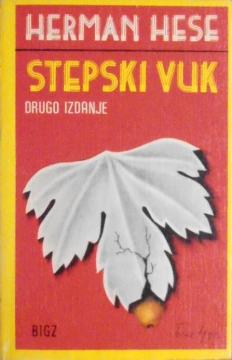
Stepski vuk

The novel follows Harry Haller, a lonely intellectual torn between the human pursuit of spirituality and the wild, animal nature of the "steppe wolf". Through an identity crisis, he searches for meaning in the modern world.
Steppenwolf (1927) is one of the most famous works by the German-Swiss writer Hermann Hesse, written during a period of profound personal and existential crisis. Through the device of a discovered manuscript, the novel presents the confession of Harry Haller, a forty-year-old intellectual who views himself as a being split into two irreconcilable halves: the lofty human spirit and the raw, solitary "Steppenwolf." Haller despises the superficiality of bourgeois society, as well as the pettiness and militarism of his era, yet he fails to find inner peace or a sense of belonging. A turning point occurs during a night out when he meets Hermine, a mysterious woman who introduces him to an entirely new world of physical pleasures, dance, jazz, and intoxicants. Hermine shatters his illusion of a simple duality, teaching him that the human soul is composed not merely of two parts, but of an infinite multitude of layers. Through her, he also meets Pablo, a saxophonist, and a young woman named Maria; together, they help him break free from his rigid intellectual stiffness. The novel reaches its climax in the "Magic Theater"—a surreal realm of the subconscious and fantasy where, through a series of symbolic images, Harry learns to embrace every aspect of his personality. Using the motifs of humor and laughter, Hesse offers the only true remedy for despair: the individual's ability not to take themselves too seriously and to discover a higher spiritual harmony amidst the absurdity of everyday life.
One copy is available