Voće tela

Voće tela

Milan Ranković

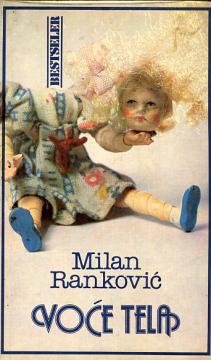
"Fruits of the Body" (1983) is a novel by Milan Ranković that explores physicality as a source of pleasure, suffering and social interaction in the context of Yugoslav socialism. The novel remains an under-read gem of Yugoslav prose in the 1980s.

The main character, a middle-aged intellectual and aesthetician like the author himself, leads us through an introspective search for the meaning of physical existence. Through a series of fragments and monologues, Ranković examines the "fruits of the body" – metaphorically the fruits of bodily experiences: love affairs, parenthood, illness and artistic inspiration.

The plot, structured in a labyrinth, moves between Belgrade and Zagreb, where the protagonist encounters former lovers, colleagues and anonymous encounters that reveal the contrasts between the idealized aesthetics of the body in art and the harsh reality of everyday life. In one key segment, the character is confronted by a young artist who accuses him of compromising with the body in favor of ideology, triggering a deep self-reflection on sexuality as resistance to the system.

The novel emphasizes Ranković's background as an art theorist – influences from Kafka to Barthes – criticizing the repression of the body under socialism and celebrating its sensuality. The style is fragmentary, poetic, full of allegories (the body as a garden, the fruit as sin and reward), with doses of humor and irony towards bureaucratic Yugoslavia. As part of Ranković's late phase, the work connects his earlier essays on aesthetics with fiction, leaving the reader with the question: is the body the fruit or the burden of freedom?

Editor
Zdravko Židovec
Graphics design
Nenad Dogan
Dimensions
20 x 15 cm
Pages
218
Publisher
August Cesarec, Zagreb, 1983.
 
Latin alphabet. Hardcover with dust jacket.
Language: Croatian.

Two copies are available

Copy number 1

Condition:Used, excellent condition

Copy number 2

Condition:Used, excellent condition
 

Are you interested in another book? You can search the offer using our search engine or browse books by category.

You may also be interested in these titles

Crna kutija

Crna kutija

Amos Oz

The Black Box is a kaleidoscope of married life and love relationships. It is a novel that implicitly speaks about all of us.

Hena Com, 2001.
Croatian. Latin alphabet. Hardcover.
10.98
Malena je ime tanga

Malena je ime tanga

Almudena Grandes

If you like raw eroticism like Cloud Atlas, this is a sensual saga – emotional, provocative, for those who want to feel the pulse of forbidden passion! Grandes probes whether love is a curse or a liberation?

Mozaik knjiga, 2000.
Croatian. Latin alphabet. Hardcover.
8.546.40
Štefica Cvek u raljama života

Štefica Cvek u raljama života

Dubravka Ugrešić

Do you like "lovelies"? Whatever you think about them, you'll enjoy this superb pastiche of trivial romance novels.

Mladinska knjiga, 1990.
Croatian. Latin alphabet. Hardcover with dust jacket.
4.94
Krčma

Krčma

Julian Stryjkowski

The book "Inn" by Julian Stryjkowski, published in 1977, explores life in a small Jewish village in Galicia during the 19th century.

BIGZ, 1977.
Serbian. Latin alphabet. Paperback.
4.38
Dok ležah na samrti

Dok ležah na samrti

William Faulkner

Faulkner's 1930 novel, a classic example of modernist literature. It is often compared to Joyce's "Ulysses" for its innovative structure, but is more accessible due to its focus on family.

Rad, 1985.
Croatian. Latin alphabet. Paperback.
3.26
Usta puna zemlje

Usta puna zemlje

Branimir Šćepanović

The novel "Usta puna zemlje" (1970), the masterpiece of the Serbian writer Branimir Šćepanović, is a psychologically in-depth explorer of the limits of the human soul, solitude and existential freedom, reminiscent of Kafka and Camus.

BIGZ, 1987.
Serbian. Latin alphabet. Paperback.
3.96 - 3.98