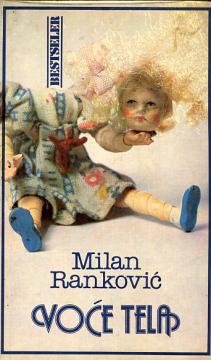
Voće tela

Voće tela

Milan Ranković

"Fruits of the Body" (1983) is a novel by Milan Ranković that explores physicality as a source of pleasure, suffering and social interaction in the context of Yugoslav socialism. The novel remains an under-read gem of Yugoslav prose in the 1980s.

The main character, a middle-aged intellectual and aesthetician like the author himself, leads us through an introspective search for the meaning of physical existence. Through a series of fragments and monologues, Ranković examines the "fruits of the body" – metaphorically the fruits of bodily experiences: love affairs, parenthood, illness and artistic inspiration.

The plot, structured in a labyrinth, moves between Belgrade and Zagreb, where the protagonist encounters former lovers, colleagues and anonymous encounters that reveal the contrasts between the idealized aesthetics of the body in art and the harsh reality of everyday life. In one key segment, the character is confronted by a young artist who accuses him of compromising with the body in favor of ideology, triggering a deep self-reflection on sexuality as resistance to the system.

The novel emphasizes Ranković's background as an art theorist – influences from Kafka to Barthes – criticizing the repression of the body under socialism and celebrating its sensuality. The style is fragmentary, poetic, full of allegories (the body as a garden, the fruit as sin and reward), with doses of humor and irony towards bureaucratic Yugoslavia. As part of Ranković's late phase, the work connects his earlier essays on aesthetics with fiction, leaving the reader with the question: is the body the fruit or the burden of freedom?

Urednik
Zdravko Židovec
Naslovnica
Nenad Dogan
Dimenzije
20 x 15 cm
Broj strana
218
Nakladnik
August Cesarec, Zagreb, 1983.
 
Latinica. Tvrde korice s ovitkom.
Jezik: Hrvatski.

Dva primjerka su u ponudi

Primjerak broj 1

Stanje:Korišteno, u odličnom stanju
Dodano u košaricu!

Primjerak broj 2

Stanje:Korišteno, u odličnom stanju
Dodano u košaricu!
 

Zanima Vas i neka druga knjiga? Možete pretražiti našu ponudu pomoću tražilice ili prelistati knjige po kategorijama.

Možda će Vas zanimati i ovi naslovi

Bilješka o piscu: Neljubavni roman

Bilješka o piscu: Neljubavni roman

Julijana Matanović

A Writer's Note is the first bestseller by beloved Croatian author Julijana Matanović. A hit since its publication, the novel reminds us that the past cannot be erased, only understood.

Mozaik knjiga, 2002.
Hrvatski. Latinica. Broširano.
6,36 - 6,38
Deobe

Deobe

Dobrica Ćosić

Deobe is a novel about the tragic division of Serbs into Chetniks and Partisans during World War II. Winner of the NIN Award, it is part of a wider epic trilogy, inspired by Ćosić's experiences and historical documents.

Prosveta, 1963.
Hrvatski. Latinica. Tvrde korice s ovitkom.
13,74
Andrićeva lestvica užasa

Andrićeva lestvica užasa

Svetislav Basara

A Serbian writer known for his satirical novels, Andrić's Ladder of Horrors dissects the Balkan mentality through a parable of Yugo-nostalgia and national myths. The title alludes to Ivo Andrić as a litmus test for criticism – Balkans claim him or reject

24 sata, 2021.
Srpski. Latinica. Broširano.
11,56
Godan

Godan

Munshi Prem Chand
Kosmos, 1960.
Srpski. Latinica. Broširano.
4,22 - 4,26
Stotina godina (antikronika)

Stotina godina (antikronika)

Dario Harjaček

The novel One Hundred Years by Dario Harjaček provides a panoramic view of Trešnjevka and its inhabitants through a century of changes, ideologies, and human destinies – a mosaic of Zagreb in which life, art, and history intertwine.

Oceanmore, 2025.
Hrvatski. Latinica. Broširano.
13,42
Proces

Proces

Franz Kafka

Kafka wrote The Process between 1914 and 1915, published posthumously in 1925. The novel is unfinished but with an added final chapter by Max Brod. Edition with a foreword by B. Živojinović and an afterword by Walter Killi.

BIGZ, 1990.
Srpski. Latinica. Broširano.
4,26