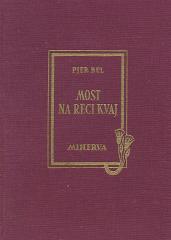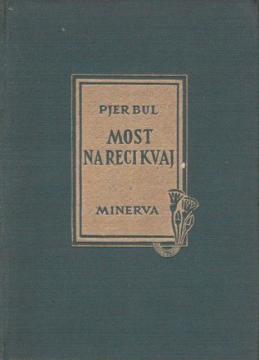
Most na reci Kvaj / Dželat

Most na reci Kvaj / Dželat

Pierre Boulle

The Bridge on the River Kwai (1952) is a famous story about British prisoners who, under pressure from the Japanese, build a bridge in the jungle. The Executioner (1954) is a philosophical novella about a Chinese executioner who becomes a victim of his ow

The Bridge on the River Kwai is Boulle's most famous work (based on the Oscar-winning film by David Lean). The novel is based on the author's wartime experience in Asia. It depicts British prisoners in a Japanese camp in Burma who are forced by their commander, Colonel Nicholson, to build a perfect bridge over the River Kwai. The novel subtly explores themes of military honor, the absurdity of war, collaboration, and fanaticism. Boulle masterfully shows how a British officer, in the name of discipline and pride, helps the enemy, while the Japanese becomes almost sympathetic in his rigidity. The work is an ironic parable about war and human nature.

The Executioner is a short philosophical novella set in ancient China. The main character is a professional executioner who has been carrying out death sentences for centuries, following a family tradition. When the system he has served his entire life condemns him to death, he becomes a victim of his own role. The novel is a powerful existential parable about responsibility, justice, violence, and the meaninglessness of human destiny. Here Boulle demonstrates an extraordinary ability to pose profound philosophical questions through a simple story.

Both works are characterized by precise style, irony, and moral ambiguity – Boulle never judges directly, but rather makes the reader think. The Minerva edition has combined these two novels into one book, which is a frequent occurrence with Boulle, as both share similar themes of absurdity and human tragicomedy.

Original title
Le Pont de la rivière Kwaï / Le Bourreau
Translation
Zorica Mišković
Editor
Tanasije Mladenović
Illustrations
Olivera Mitrašinović
Graphics design
Stevan Vujkov
Dimensions
20 x 14.5 cm
Pages
262
Publisher
Minerva, Subotica, 1959.
 
Latin alphabet. Hardcover.
Language: Serbian.

One copy is available

Condition:Used, excellent condition
 

Are you interested in another book? You can search the offer using our search engine or browse books by category.

You may also be interested in these titles

Most na reci Kvaj / Dželat

Most na reci Kvaj / Dželat

Pierre Boulle

The novel The Bridge on the River Kwai by Pierre Boulle is a classic anti-war work that explores the absurdities and tragedies of war. The action takes place during World War II in a Japanese POW camp in Thailand.

Minerva, 1968.
Serbian. Latin alphabet. Hardcover.
3.42
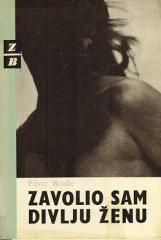
Zavolio sam divlju ženu

Zavolio sam divlju ženu

Pierre Boulle

The novel originally titled La Planete des singes, which was the basis for the 1968 film Planet of the Apes.

Epoha, 1965.
Croatian. Latin alphabet. Hardcover with dust jacket.
5.98
Zmija oko vrata I-II

Zmija oko vrata I-II

Lydia Scheuermann-Hodak

War-psychological prose set during the Homeland War (1991–1995), with a focus on Slavonia and partly on events in Bosnia. The work belongs to a cycle of prose about the war and women's experiences in it.

Grafika, 2004.
Croatian. Latin alphabet. Paperback.
The book consists of two volumes
9.76
Baraka Pet Be i druge novele

Baraka Pet Be i druge novele

Miroslav Krleža

The collection "Baraka Pet Be i druge novele" brings a selection of Krleža's anti-war novels from the period 1916–1920s, focusing on the senselessness of World War I, the suffering of the Home Guard and the downfall of Austria-Hungary.

Mladost, 1987.
Croatian. Latin alphabet. Hardcover.
5.38
Sanjaj nemogući san

Sanjaj nemogući san

Johannes Mario Simmel

From the bestselling author of "Jimmy and the Rainbow," comes a novel that weaves a love story with the stirring events of the Bosnian war. This story, woven into the historical context, reminds us that sometimes the impossible dream is the only one worth

Mozaik knjiga, 1997.
Croatian. Latin alphabet. Hardcover.
7.42
Čočara

Čočara

Alberto Moravia

Widow Cesira and her daughter Rosetta flee bombed Rome to their native Ciociaria, where they experience hunger, fear and misery. Liberation brings tragedy: Rosetta is raped by Moroccan soldiers, destroying their faith in God and people.

Otokar Keršovani, 1966.
Croatian. Latin alphabet. Hardcover.
3.96