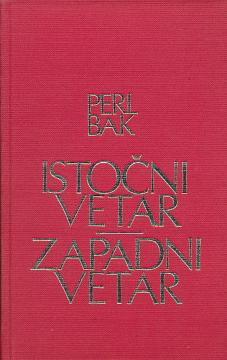
Sabrana dela 7: Istočni vetar – zapadni vetar
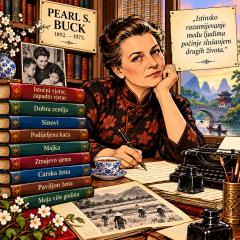
"East Wind, West Wind" (1930) is one of Pearl S. Buck's early novels. In an arranged marriage to a Western-educated husband, young Kwei-lan slowly abandons tradition and discovers love in the clash of two cultures.
In a small Chinese town at the beginning of the 20th century, Kwei-lan, a girl from a respectable traditional family, lives. Since childhood, her feet have been bound according to old customs, and her marriage was arranged long ago with a young man she has never seen. When she finally enters into this marriage, she is faced with a complete shock: her husband is a doctor who was educated in America and brought with him a completely different view of the world. He does not want a submissive wife who will serve him as a slave, but an equal partner. He rejects concubines, ridicules superstitions and demands that Kwei-lan change.
At first, the young woman is deeply unhappy and confused. She feels rejected because she does not understand his wishes, and he does not accept her traditional role. But her love for him is stronger than her fear. Through great physical pain and emotional struggle, she decides to untie her feet - an act that symbolizes her willingness to free herself from her old shackles. As she recovers, her husband truly cares for her for the first time, and a real closeness begins to blossom between them.
Gradually, Kwei-lan learns new customs, discovers the joy of motherhood, and realizes that marriage can be a partnership, not just a duty. Her inner world expands: she begins to appreciate the knowledge, hygiene, open conversation, and individual freedom that Western influence brings, but she does not lose her Chinese soul.
At the same time, another drama unfolds in the family. Her brother, also educated in America, rejects an arranged marriage and falls in love with an American woman. His decision shatters the traditional order and causes her mother deep pain, showing how rapid change tears entire families apart.
Through Kwei-lan's story, Pearl S. Buck subtly depicts the collision of two civilizations - the east wind of tradition and the west wind of modernity. The novel is not only a love story, but also a tender portrait of a woman who reconciles the old and the new, fear and courage, the past and the future. Buck writes with a deep understanding of Chinese culture, but also with the hope that love and openness can overcome deep divisions. The book radiates warmth, intimacy, and faith in the human capacity for change.
Multiple copies are available