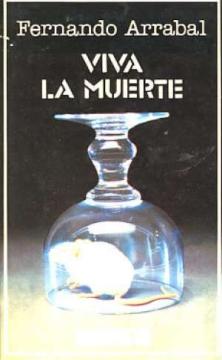
Viva la muerte: Baal babilonski
A sick young man recapitulates his upbringing in clerical-fascist Spain through memories and visions. This autobiographical novel served as a direct template for Arrabal's cult film Viva la muerte.
Viva la muerte: Baal Babylone (Baal Babylone, 1959) is an autobiographical novel by Fernando Arrabal, written in the form of an interrupted inner monologue. The protagonist, confined to a hospital bed, sank into memories of his childhood marked by the Spanish Civil War. Through fragments of memories, letters and feverish visions, the boy tries to fathom the fate of his anti-fascist father, who was reported to the clero-fascist regime by his own fanatically religious wife.
It was this novel that served as the main literary template according to which Arrabal directed his famous film debut Viva la muerte in 1971.
With a name that evokes ancient deities and biblical Babylon, the author describes the oppressive and morally depraved world in which he grew up. Applying the aesthetic principles of his Théâtre Panique (Théâtre Panique), Arrabal interweaves children's naivety, dark eroticism, dark humor, sacred iconography and grotesque violence. The novel provides a poignant analysis of a child's psyche torn between the desire for a mother's love and abhorrence of her betrayal, revealing how ideological fanaticism destroys the most intimate family relationships.
Two copies are available
Copy number 2
- Library stamp
- The cover is missing