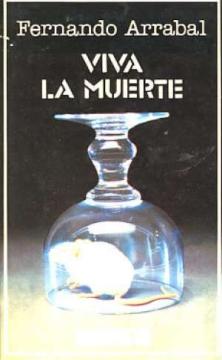
Viva la muerte: Baal babilonski

Viva la muerte: Baal babilonski

Fernando Arrabal

A sick young man recapitulates his upbringing in clerical-fascist Spain through memories and visions. This autobiographical novel served as a direct template for Arrabal's cult film Viva la muerte.

Viva la muerte: Baal Babylone (Baal Babylone, 1959) is an autobiographical novel by Fernando Arrabal, written in the form of an interrupted inner monologue. The protagonist, confined to a hospital bed, sank into memories of his childhood marked by the Spanish Civil War. Through fragments of memories, letters and feverish visions, the boy tries to fathom the fate of his anti-fascist father, who was reported to the clero-fascist regime by his own fanatically religious wife.

It was this novel that served as the main literary template according to which Arrabal directed his famous film debut Viva la muerte in 1971.

With a name that evokes ancient deities and biblical Babylon, the author describes the oppressive and morally depraved world in which he grew up. Applying the aesthetic principles of his Théâtre Panique (Théâtre Panique), Arrabal interweaves children's naivety, dark eroticism, dark humor, sacred iconography and grotesque violence. The novel provides a poignant analysis of a child's psyche torn between the desire for a mother's love and abhorrence of her betrayal, revealing how ideological fanaticism destroys the most intimate family relationships.

Naslov izvornika
Baal Babylone
Prijevod
Ljiljanka Lovrinčević
Urednik
Zdravko Židovec
Ilustracije
Petar Dabac
Naslovnica
Nenad Dogan
Dimenzije
20 x 13 cm
Broj strana
166
Nakladnik
August Cesarec, Zagreb, 1981.
 
Latinica. Tvrde korice s ovitkom.
Jezik: Hrvatski.

Dva primjerka su u ponudi

Primjerak broj 1

Stanje:Korišteno, u odličnom stanju
Dodano u košaricu!

Primjerak broj 2

Stanje:Korišteno, u dobrom stanju (tragovi korištenja)
Oštećenja / nepogodnosti:
  • Library stamp
  • The cover is missing
Snižena cijena: 3,992,66
Popust od 33% vrijedi do 31.12.2026. 23:59
Dodano u košaricu!
 

Zanima Vas i neka druga knjiga? Možete pretražiti našu ponudu pomoću tražilice ili prelistati knjige po kategorijama.

Možda će Vas zanimati i ovi naslovi

Poljubac žene-pauka

Poljubac žene-pauka

Manuel Puig

The book, banned in Argentina from 1976 to 1983 due to its political and social themes, is considered Puig's most successful work. It was adapted into a film in 1985, a musical, and a stage play.

Prosveta, 1985.
Srpski. Latinica. Tvrde korice s ovitkom.
4,84
Brat od leda

Brat od leda

Alicia Kopf

A hybrid novel by a Catalan writer about an autistic brother, polar expeditions and her own existential insecurity. An intimate story about family, art and survival in an unpredictable world.

Hena Com, 2020.
Hrvatski. Latinica. Tvrde korice s ovitkom.
12,42
Neprijatelj

Neprijatelj

Miguel Aranguren

Spanish author Miguel Aranguren, one of the leading novelists of his generation, creates a tense spiritual, deeply Christian police thriller that combines occultism, crime, and religious struggle.

Verbum, 2010.
Hrvatski. Latinica. Tvrde korice.
11,26
Malena je ime tanga

Malena je ime tanga

Almudena Grandes

If you like raw eroticism like Cloud Atlas, this is a sensual saga – emotional, provocative, for those who want to feel the pulse of forbidden passion! Grandes probes whether love is a curse or a liberation?

Mozaik knjiga, 2000.
Hrvatski. Latinica. Tvrde korice.
7,96 - 8,54
Najbolje što se može dogoditi jednom kroasanu

Najbolje što se može dogoditi jednom kroasanu

Pablo Tusset

What happens when Pablo Baloo Miralles, a lazy and maladjusted thirty-year-old pleasure hunter and famous philosopher of the Web, in search of his rich brother The First, becomes involved in a secret hidden in a seemingly peaceful neighborhood of Barcelon

Naklada MD, 2004.
Hrvatski. Latinica. Broširano.
12,32
Tajna zelene ptice

Tajna zelene ptice

Luis Coloma

The Secret of the Green Bird (1910) is a novel by Spanish writer and Jesuit Luis Coloma, an author also known for the story of Ratoncito Pérez, about a young man from a Spanish aristocratic family who grew up without a mother under the influence of a domi

Hrvatsko književno društvo Sv. Jeronima, 1928.
Hrvatski. Latinica. Tvrde korice.
4,72