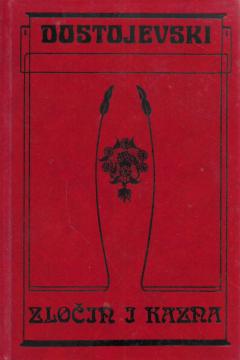

Zločin i kazna

Zločin i kazna

Fjodor Mihajlovič Dostojevski

The novel Crime and Punishment (1866) by Fyodor Mikhailovich Dostoevsky, a masterpiece of world literature, is a profound psychological and philosophical exploration of guilt, morality, and redemption.

Set in impoverished Petrograd, it follows Rodion Raskolnikov, an impoverished former student who, obsessed with the idea of ​​a superman, murders the elderly moneylender Alena Ivanovna and her sister Lizaveta, believing that the act is morally justified if it serves a greater purpose.

Tormented by poverty and nihilistic ideas, Raskolnikov rationalizes the crime by considering the moneylender a nuisance to society. However, after the murder, he is overcome by paranoia, guilt, and internal conflict. The novel traces his psychological disintegration as he struggles with feelings of remorse and fear of discovery. Key characters, such as Sonya Marmeladova, a prostitute who embodies suffering and faith, and the investigator Porfiry Petrovich, who psychologically oppresses Raskolnikov, help to expose his inner turmoil.

Dostoevsky explores themes of moral responsibility, freedom, and suffering, contrasting atheistic nihilism with Christian redemption. Through Raskolnikov's journey from crime to confession and imprisonment, the novel emphasizes the possibility of spiritual renewal. The style is dense, with deep psychological portraits and philosophical dialogues, making the work a universal meditation on human nature and social injustices.

Original title
Преступление и наказание
Translation
Zlatko Crnković, Ivan Kušan
Editor
Jakša Kušan
Graphics design
Boris Dogan
Dimensions
21 x 14 cm
Pages
530
Publisher
Znanje, Zagreb, 1982.
 
Latin alphabet. Hardcover.
Language: Croatian.

One copy is available

Condition:Used, excellent condition
 

Are you interested in another book? You can search the offer using our search engine or browse books by category.

You may also be interested in these titles

Zločin i kazna

Zločin i kazna

Fjodor Mihajlovič Dostojevski

Crime and Punishment is a novel by Russian writer Fyodor Mikhailovich Dostoevsky, published in 1866 in the journal Russian Herald. It is considered one of the greatest works of Russian literature. The plot is set in Saint Petersburg in the mid-1860s.

Rad, 1988.
Serbian. Latin alphabet. Hardcover.
7.60
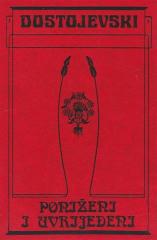
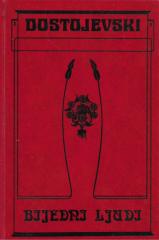
Ujakov san / Poniženi i uvrijeđeni

Ujakov san / Poniženi i uvrijeđeni

Fjodor Mihajlovič Dostojevski

Both works reflect Dostoevsky's early phase, with a focus on social criticism, psychological analysis and moral dilemmas, foreshadowing the themes of his later masterpieces.

Znanje, 1982.
Croatian. Latin alphabet. Hardcover.
13.24 - 13.26
Svinjarija / Krokodil / Kockar / Vječiti muž

Svinjarija / Krokodil / Kockar / Vječiti muž

Fjodor M. Dostojevski

All the works published in this volume reflect Dostoevsky's ability to expose human frailties, social flaws and moral dilemmas through humor, satire and psychological depth, often with universal themes that still resonate today.

Znanje, 1982.
Croatian. Latin alphabet. Hardcover.
14.75
Sabrana djela A. P. Čehova #7: Seljaci i druge novele

Sabrana djela A. P. Čehova #7: Seljaci i druge novele

Anton Pavlovič Čehov

Between 1892, when "The Fragment", the first novella in this book, was published, and "The Peasant" (1897) and "On the Carts" (1897), A. P. Chekhov made a series of other artistically successful observations of the society in which he lived.

Zora, 1960.
Croatian. Latin alphabet. Hardcover with dust jacket.
13.62
Ruska šuma

Ruska šuma

Leonid Leonov

The novel follows Boris Kostomarov, an engineer in Soviet Russia, who, through conflicts with bureaucracy, moral questioning, and the fates of people in remote forests, reveals the complexity of Soviet society and the price of personal conscience.

Prosveta, 1960.
Serbian. Cyrillic alphabet. Hardcover with dust jacket.
6.364.77
Sabrana djela A. P. Čehova #9: Tri sestre i druge drame

Sabrana djela A. P. Čehova #9: Tri sestre i druge drame

Anton Pavlovič Čehov

Since the play Three Sisters was written in the second half of the 19th century, it rightly carries with it certain motifs and an atmosphere that runs through most literary works of that period.

Zora, 1960.
Croatian. Latin alphabet. Hardcover with dust jacket.
15.98