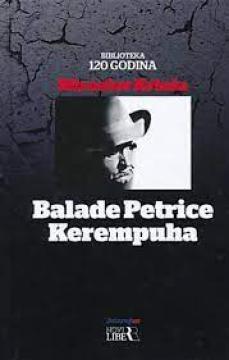
Balade Petrice Kerempuha
Miroslav Krleža's greatest poetic achievement and one of the most important works of Croatian literature. The ballads combine satire, irony, and lyrical-folkloric tones in a condemnation of violence and stupidity of government throughout the centuries.
In Ballads of Petrica Kerempuh, Miroslav Krleža creates a literary work that simultaneously acts as a historical lament, a political indictment, and a poetic fresco of the Croatian north. The main voice of the collection, the fictional Petrica Kerempuh, a folk sage and mocker, observes history “from below”: from the perspective of peasants, serfs, marginalized people, and all those over whom foreign rule has been imposed for centuries.
The collection covers a wide time span — from medieval rebellions and persecutions to the tragedies of the early modern era. Through kajkavština, a language full of rhythm, metaphors, proverbs, and ironic puns, Krleža brings to life the entire world of lost voices: victims of violence, hungry, ridiculed, deceived. Petrica moves through this landscape as a commentator, not submissive, but not naive either — his humor carries the bitterness of experience, and his irony exposes the cruelty of those in power.
In the background of the ballads, the horrors of history unfold: hangings, military campaigns, rebellions, epidemics, robberies and political persecutions. But in this darkness, Krleža also finds motives of resistance — the defiance of the peasant masses, the strength of unity, laughter as the last weapon of those who have no other. The collection thus becomes a chronicle of suffering, but also a testimony to the perseverance of a people who survive thanks to wit and unwavering hope.
Petrica, as a lyrical protagonist, embodies the combination of folk wisdom and literary mask. He sees everything: the emptiness of historical ideologies, the hypocrisy of the authorities, the repetition of tragedies. Krleža uses him to speak about centuries-old injustice, but also to show how the truth is often preserved in the language of mockers and jokes, and not in the speeches of rulers.
Two copies are available