
Quo Vadis?

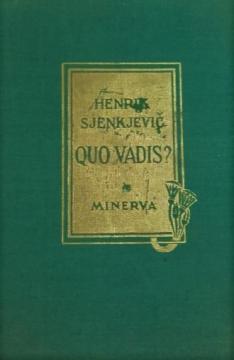
Quo Vadis?

Henryk Sienkiewicz

The novel Quo Vadis is a historical saga set in Rome during the reign of Emperor Nero. Written with epochal breadth, the work explores the conflict between early Christianity and decadent Roman society, with a love story at its center.

The main character, a young Roman patrician Marcus Vinicius, falls in love with Lygia, a Christian girl from the Liga tribe. Their love is complicated by social differences, Nero's tyranny, and the persecution of Christians. Vinicius, initially driven by passions and Roman values, gradually changes under the influence of Lygia's faith and Christian principles, especially through his encounters with the apostles Peter and Paul. Lygia, a symbol of purity and faith, flees Roman luxury and Nero's court, where the lust of Poppaea, the emperor's mistress, further endangers her.

The novel culminates in dramatic events: Nero accuses the Christians of the Great Fire of Rome, which leads to their torture in the arena. Lygia is sentenced to death, but Vinicius, with the help of the Christians, saves her. Nero's rule collapses, and Christianity rises as a new moral force. Sienkiewicz masterfully depicts the opulence and cruelty of Rome, contrasting it with Christian humility and hope. The novel ends with the triumph of love and faith, with Peter's question "Quo vadis, Domine?" (Where are you going, Lord?), symbolizing spiritual transformation.

The work is a masterpiece of world literature, awarded the Nobel Prize in 1905, and celebrates the strength of the spirit in times of persecution.

Translation
Lazar R. Knežević
Editor
Tanasije Mladenović
Illustrations
Nada Doroški
Dimensions
20 x 15 cm
Pages
572
Publisher
Minerva, Subotica, 1964.
 
Latin alphabet. Hardcover.
Language: Serbian.

One copy is available

Condition:Used, good condition (visible signs of use)
Damages or inconvenience notice:
  • Stains on cover
  • Traces of patina
 

Are you interested in another book? You can search the offer using our search engine or browse books by category.

You may also be interested in these titles

Mirza

Mirza

Henryk Sienkiewicz
Mlado pokolenje, 1967.
Serbian. Latin alphabet. Hardcover with dust jacket.
3.98 - 3.99
Mali vitez

Mali vitez

Henryk Sienkiewicz
Mladinska knjiga, 1974.
Slovenian. Latin alphabet. Paperback.
3.84
Kroz pustinju i prašumu

Kroz pustinju i prašumu

Henryk Sienkiewicz

An adventure story set in Africa at the end of the 19th century. It follows the fate of two young protagonists, 14-year-old Pole Stas Tarkowski and 8-year-old Englishwoman Nel Rawlison, who are kidnapped by Sudanese robbers in colonial Egypt.

Rad, 1986.
Serbian. Latin alphabet. Hardcover.
4.20
Dok ležah na samrti

Dok ležah na samrti

William Faulkner

Faulkner's 1930 novel, a classic example of modernist literature. It is often compared to Joyce's "Ulysses" for its innovative structure, but is more accessible due to its focus on family.

Rad, 1985.
Croatian. Latin alphabet. Paperback.
3.26
Kreutzerova sonata, Hadži-Murat

Kreutzerova sonata, Hadži-Murat

Lav Nikolajevič Tolstoj

Kreutzer's sonata belongs to those works of Tolstoy that the writer adapted in many ways to his view on moral issues, on marital morality above all.

Civitas, 2004.
Croatian. Latin alphabet. Paperback.
4.98
Stotina godina (antikronika)

Stotina godina (antikronika)

Dario Harjaček

The novel One Hundred Years by Dario Harjaček provides a panoramic view of Trešnjevka and its inhabitants through a century of changes, ideologies, and human destinies – a mosaic of Zagreb in which life, art, and history intertwine.

Oceanmore, 2025.
Croatian. Latin alphabet. Paperback.
13.42