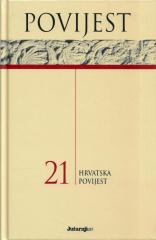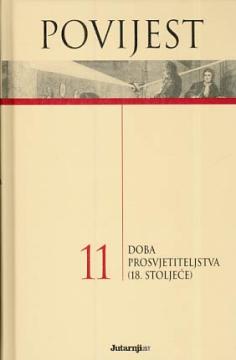
Povijest #11: Doba prosvjetiteljstva: 18. stoljeće

Povijest #11: Doba prosvjetiteljstva: 18. stoljeće

The eleventh volume of the World History edition covers the 18th century, the Age of Enlightenment, marked by rationalism, scientific progress, and political turmoil.

After the 17th century, which was marked by economic crises, religious wars, plagues and intolerance, the 18th century began to justify the name "modern era" that the period from the discovery of America in 1492 to the French Revolution in 1789 bears. The modernization of life is manifested in rapid industrialization, the development of science and technology, the organization of work is changing, but also traditional social profiles and private relationships.

Undeniable signs of modernity appear in the language of politics and theoretical debates: questions about democracy, constitutionalism, human rights and the role of public opinion arise. However, the consequences of the difficult previous century are still felt. Most of all in the system of international relations, in the form of the wars for the Spanish, Polish and Austrian inheritance and the Seven Years' War in which several countries and their colonies clashed. New powers, Russia and Prussia, appear on the European international scene in this century.

Original title
Il Settecento: L’Età dei Lumi
Translation
Ana Badurina
Editor
Ivo Goldstein
Graphics design
Guido Rosa, Luca Ferutta
Dimensions
22 x 14 cm
Pages
623
Publisher
Europapress holding, Zagreb, 2008.
 
Latin alphabet. Hardcover.
Language: Croatian.
ISBN
978-9-53300-045-9

Multiple copies are available

Copy number 1

Condition:Unused

Copy number 2

Condition:Used, excellent condition

Copy number 3

Condition:Used, excellent condition

Copy number 4

Condition:Unused
 

Are you interested in another book? You can search the offer using our search engine or browse books by category.

You may also be interested in these titles

Povijest svijeta: od najstarijeg doba do godine 1940.

Povijest svijeta: od najstarijeg doba do godine 1940.

Marko Vunić
Hrvatsko književno društvo Sv. Jeronima, 1940.
Croatian. Latin alphabet. Hardcover.
9.72
Kratka povijest ljudske rase

Kratka povijest ljudske rase

Michael Cook

Michael A. Cook, Princeton professor of Islamic history, provides an overview of human history from the Neolithic to the fall of the Twin Towers in 2001 in this witty and intelligent synthesis, asking the key question: why did everything happen exactly th

Profil Knjiga, 2009.
Croatian. Latin alphabet. Paperback.
16.2813.02
Prije potopa: Dokaz da je biblijski potop bio stvaran događaj

Prije potopa: Dokaz da je biblijski potop bio stvaran događaj

Ian Wilson

British historian Ian Wilson (known for his books on the Shroud of Turin and Jesus) offers the most thorough defense of the thesis that the biblical flood was a real historical event, not just a myth, in his work Before the Flood.

Stari grad, 2007.
Croatian. Latin alphabet. Hardcover.
16.2211.38 - 16.28
Talisman: sveti gradovi, tajna vjera

Talisman: sveti gradovi, tajna vjera

Graham Hancock, Robert Bauval

Talisman is an exciting intellectual journey through the hidden streets and underground canals of history in search of traces of the secret religion that shaped the world, hidden in architecture and monuments.

Stari grad, 2006.
Croatian. Latin alphabet. Hardcover.
24.4217.09 - 24.4618.35
Grčko čudo

Grčko čudo

Vojtech Zamarovsky

A comprehensive work that explores the extraordinary development of ancient Greek civilization and its lasting influence on Western culture. The author analyzes in detail various aspects of Greek society to demonstrate the uniqueness and significance of t

Školska knjiga, 1978.
Croatian. Latin alphabet. Hardcover.
32.64
Opuscula archaeologica IV: Zlatni nakit iz helenističko-ilirske nekropole u Budvi

Opuscula archaeologica IV: Zlatni nakit iz helenističko-ilirske nekropole u Budvi

Duje Rendić-Miočević

The article presents a classic analysis of archaeological findings from the Hellenistic period (3rd-2nd century BC) in the necropolis north of ancient Budva (today's Montenegro), discovered in the 1950s.

Filozofski fakultet Sveučilišta u Zagrebu, 1959.
Croatian. Latin alphabet. Paperback.
9.36