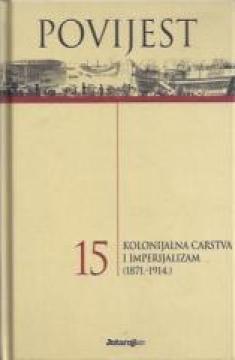
Povijest #15: Kolonijalna carstva i imperijalizam (1871.-1914.)

Povijest #15: Kolonijalna carstva i imperijalizam (1871.-1914.)

The fifteenth volume of the World History series covers the period from 1871 to 1914, marked by the height of colonialism and imperialism. The book is richly illustrated, providing a comprehensive account of this period of global change and tension.

Europe experiences the Second Industrial Revolution, with innovations such as electricity, steel, and the chemical industry, which boost economic power and urbanization. The Great Powers (Britain, France, Germany) divide Africa and Asia, creating vast colonial empires. The "Scramble for Africa" culminates in the Berlin Conference (1884–1885), while imperialism spreads to the Far East.

Nationalism grows, fueling tensions among European powers. Alliances (Triple Alliance and Entente) and militarization increase the risk of conflict. The Balkan Wars (1912–1913) further destabilize the region. Socially, labor movements and unions grow stronger, while socialism and feminism fight for rights. Culturally, Secession and Impressionism change art, and science advances through discoveries such as radio and the theory of relativity.

In the Croatian context, the emphasis is on the position within Austria-Hungary, the national revival, and the struggle for autonomy under the leadership of Stjepan Radić. The period ends on the eve of World War I, the causes of which lie in imperialist rivalries and national conflicts.

Original title
"L’Ottocento: Imperi Coloniali e Imperialismo
Translation
Ana Badurina
Editor
Enrico Cravetto, Ivo Goldstein
Dimensions
21 x 14 cm
Pages
647
Publisher
Europapress holding, Zagreb, 2008.
 
Latin alphabet. Hardcover.
Language: Croatian.
ISBN
978-9-53300-052-7

Two copies are available

Copy number 1

Condition:Unused

Copy number 2

Condition:Unused
 

Are you interested in another book? You can search the offer using our search engine or browse books by category.

You may also be interested in these titles

Opuscula archaeologica IV: Zlatni nakit iz helenističko-ilirske nekropole u Budvi

Opuscula archaeologica IV: Zlatni nakit iz helenističko-ilirske nekropole u Budvi

Duje Rendić-Miočević

The article presents a classic analysis of archaeological findings from the Hellenistic period (3rd-2nd century BC) in the necropolis north of ancient Budva (today's Montenegro), discovered in the 1950s.

Filozofski fakultet Sveučilišta u Zagrebu, 1959.
Croatian. Latin alphabet. Paperback.
9.36
Grčko čudo

Grčko čudo

Vojtech Zamarovsky

A comprehensive work that explores the extraordinary development of ancient Greek civilization and its lasting influence on Western culture. The author analyzes in detail various aspects of Greek society to demonstrate the uniqueness and significance of t

Školska knjiga, 1978.
Croatian. Latin alphabet. Hardcover.
32.64
Arktička pradomovina Veda

Arktička pradomovina Veda

Bal Gandahar Tilak

The book The Arctic Homeland of the Vedas (1903) by the Indian scholar Tilak proposed the hypothesis that the ancient Aryans, the authors of the Rigveda, originated in the Arctic region. Although controversial, the book remains important in the study of V

NIRO Književne novine, 1987.
Serbian. Latin alphabet. Paperback.
17.56
Prije potopa: Dokaz da je biblijski potop bio stvaran događaj

Prije potopa: Dokaz da je biblijski potop bio stvaran događaj

Ian Wilson

British historian Ian Wilson (known for his books on the Shroud of Turin and Jesus) offers the most thorough defense of the thesis that the biblical flood was a real historical event, not just a myth, in his work Before the Flood.

Stari grad, 2007.
Croatian. Latin alphabet. Hardcover.
16.22 - 16.28
Ciklus svemirskih katastrofa: Potopi, požari i skapavanja u povijesti civilizacije

Ciklus svemirskih katastrofa: Potopi, požari i skapavanja u povijesti civilizacije

Richard Firestone, Allen West, Simon Warwick-Smith

The book is the most readable and complete overview of the evidence that human civilization has already been nearly wiped out of the universe once – and that such cycles may repeat themselves every few tens of thousands of years.

Stari grad, 2007.
Croatian. Latin alphabet. Hardcover.
21.22 - 21.34
Ilustrirana povijest svijeta: Rani srednji vijek (907.-1154.)

Ilustrirana povijest svijeta: Rani srednji vijek (907.-1154.)

Karin Feuerstein-Praßer, Andrea Groß-Schulte, Marion Jung, Cornelia Lawrenz, Karin Prager, Otto S...

The fourth volume of Reader's Digest's "Illustrated History of the World" series, illustrated in color, intended for history buffs, provides an overview of key events and civilizational achievements around the world, in the period from 907 to 1154.

Mozaik knjiga, 2010.
Croatian. Latin alphabet. Hardcover.
11.56