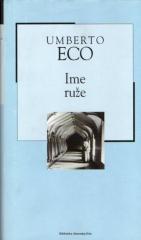

Ime ruže

Ime ruže

Umberto Eco

"The Name of the Rose", Umberto Eco's debut novel originally published in 1980, is an erudite crime novel, but also a brilliant book on medieval philosophy, history, theology and logic.

The story is told from the perspective of Adso of Melk, a young monk who accompanies the Sherlock Holmes-inspired Franciscan William of Baskerville to a monastery where they investigate a series of mysterious deaths. The monastery, a center of learning and culture, houses a valuable library, but also hides dark secrets. The deaths of the monks are linked to a mysterious book – Aristotle’s treatise on comedy – which provokes conflicts between the monks, the Inquisition and the church authorities.

William’s rational approach to research clashes with fanaticism and dogmatic attitudes, especially with the figure of Bernardo Gui, the inquisitor. Through complex dialogues, Eco discusses the conflict between reason and faith, freedom of thought and authority. The labyrinthine library symbolizes the search for knowledge, but also the danger of its suppression. The novel culminates in a tragic denouement, where the truth comes to light, but at great cost.

Eco masterfully combines erudition, suspense, and humor, creating a novel that is both an exciting mystery and a profound meditation on the human need for meaning.

Original title
Il nome della rosa
Translation
Morana Čale
Editor
Nenad Popović
Graphics design
Zoran Pavlović
Dimensions
20 x 12 cm
Pages
551
Publisher
Grafički zavod Hrvatske (GZH), Zagreb, 1984.
 
Latin alphabet. Hardcover with dust jacket.
Language: Croatian.

No copies available

The last copy was sold recently.

 

Are you interested in another book? You can search the offer using our search engine or browse books by category.

You may also be interested in these titles

U potrazi za savršenim jezikom

U potrazi za savršenim jezikom

Umberto Eco
Hena Com, 2004.
Croatian. Latin alphabet. Hardcover with dust jacket.
17.26 - 17.36
Konjički gambit

Konjički gambit

William Faulkner

‘It was never just a game that reflected all human passion and hope and madness, and then it came true.’ ‘Okay,’ said the young man, ‘don’t say you weren’t warned.’

Izdavački zavod Jugoslavija, 1967.
Serbian. Latin alphabet. Paperback.
4.98
Kornel večernji

Kornel večernji

Deszo Kosztolanyi

Deze Kostolanyi is an exceptional Hungarian artist, originally from Subotica, who has achieved success in many literary genres, from poetry to essays to theater plays.

Dereta, 1999.
Serbian. Cyrillic alphabet. Paperback.
8.28
Prelazni period: Dnevnik posmatrača

Prelazni period: Dnevnik posmatrača

Mihailo Lalić

„Prelazni period“ je roman crnogorskog i srpskog pisca Mihaila Lalića, objavljen 1988. godine. Rad ima podnaslov „Dnevnik jednog posmatrača“, što sugeriše introspektivan i refleksivan pristup pripovedanju.

Nolit, 1988.
Croatian. Latin alphabet. Hardcover.
7.52
Narcis i Zlatousti

Narcis i Zlatousti

Hermann Hesse

The book tells about the different life paths and different worldviews of Narcissus, a monk and scholar, focused exclusively on the spiritual, and Zlatoust, an artist, who wants to immortalize the worldly and glorify God through the visible with his creat

Svjetlost, 1986.
Serbian. Latin alphabet. Hardcover.
7.32
Kao suza u okeanu I-II

Kao suza u okeanu I-II

Manes Sperber

A trilogy by Austrian-French writer and psychologist Manès Sperber, which, through three novels – "Dust and Ashes", "In the Vortex" and "Memories and Shadows" – explores the themes of totalitarianism, ideological blindness and human suffering during the t

Matica srpska, 1997.
Serbian. Cyrillic alphabet. Paperback.
The book consists of two volumes
9.38