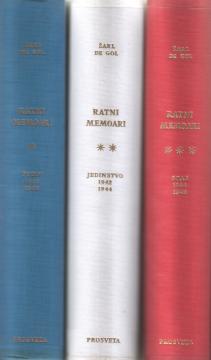
Ratni memoari

Ratni memoari

Charles de Gaulle

The three-volume "War Memoirs" of Charles de Gaulle present a personal and political account of World War II from the perspective of one of the most important French statesmen of the 20th century.

The first volume, L'Appel: 1940–1942, covers the period from the defeat of France and de Gaulle's famous appeal from London on June 18, 1940, through the organization of Free France, until its recognition by the Allies. De Gaulle details the political and military struggle against the Vichy regime and Nazi Germany, with an emphasis on the legitimacy of the government in exile.

The second volume, L'Unité: 1942–1944, focuses on the growth of Free France, the unification of various resistance movements, and the consolidation of de Gaulle's rule. The increasing role of the French in the Allied effort is also shown, including participation in the invasion of Normandy.

The third volume, Le Salut: 1944–1946, describes the liberation of France, the establishment of a provisional government, and the political challenges de Gaulle faced. The memoir ends with his stepping down from power in 1946, which he portrays as an act of consistency and respect for democracy.

Memoirs are not only a historical document but also a personal reflection on responsibility, leadership and national honor, written in a classical style full of pathos and political wisdom.

Original title
Memoires de guerre
Translation
Ljubica Vuković
Dimensions
21 x 14 cm
 
The book consists of 3 volumes.
Pages total
1997
Publisher
Prosveta, Beograd, 1968.
 
Latin alphabet. Hardcover with dust jacket.
Language: Serbian.

No copies available

The last copy was sold recently.

 

Are you interested in another book? You can search the offer using our search engine or browse books by category.

You may also be interested in these titles

Nevidljivi neprijatelj na Atlantiku 1-2

Nevidljivi neprijatelj na Atlantiku 1-2

Boris Prikril

The book provides a detailed account of naval conflicts in the Atlantic Ocean during World War II, with particular emphasis on the Battle of the Atlantic Convoy and the activities of German submarines – the so-called "invisible enemy".

Znanje, 1985.
Croatian. Latin alphabet. Hardcover with dust jacket.
The book consists of two volumes
6.98
Na rubu revolucije - studenti '71.

Na rubu revolucije - studenti '71.

Tihomir Ponoš

This is the first book that comprehensively addresses the phenomenon of Croatian students and their role in the Croatian Spring. Students, along with the reform wing of the League of Communists and Matica Hrvatska, were one of the three pillars of the Cro

Profil International, 2007.
Croatian. Latin alphabet. Paperback.
9.567.65
Turska noć

Turska noć

Philippe Videlier

The crime against the Armenians is only coming to light today. After almost a century, the tragedy of a nation, the indifference of the Constantinople authorities, the media cover-up and the turning of the international community's head are unfolding befo

Durieux, 2010.
Croatian. Latin alphabet. Hardcover with dust jacket.
11.42
Zaraćeno poraće: Konfliktni i konkurentski narativi o stradanju i iseljavanju Talijana Istre

Zaraćeno poraće: Konfliktni i konkurentski narativi o stradanju i iseljavanju Talijana Istre

Franko Dota

The book analyzes how conflicting historical narratives about the suffering and mass emigration of Italians from Istria and Rijeka developed in Croatia and Italy after World War II (1943–1956), debunking myths and encouraging an empathetic approach to the

Srednja Europa, 2010.
Croatian. Latin alphabet. Paperback.
11.328.49
Filozofija revolucije

Filozofija revolucije

Gamal Abdel Nasser

G. A. Nasser's Philosophy of Revolution is a political manifesto and ideological program of the Egyptian Revolution of 1952. In it, Nasser explains the motives of the revolution, the role of Egypt in the Arab and African world, and the vision of Arab nati

Džepna knjiga, 1956.
Serbian. Latin alphabet. Paperback.
9.56
Razgovor s poviješću

Razgovor s poviješću

Oriana Fallaci

A Conversation with History is not just a collection of interviews, but also a reflection on history, politics, and human nature. The book exposes the complexities of powerful people and their influence on the world, making it a must-read for history and

August Cesarec, 1979.
Croatian. Latin alphabet. Hardcover with dust jacket.
11.26