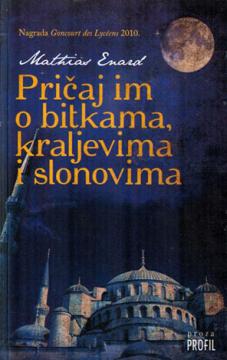
Pričaj im o bitkama, kraljevima i slonovima

Pričaj im o bitkama, kraljevima i slonovima

Mathias Énard

In 1506, Michelangelo Buonarroti was invited by Sultan Bayezid II to design a bridge across the Golden Horn in Constantinople. Furious at Pope Julius II who had humiliated him and refused to pay, Michelangelo left Rome and arrived by ship in Constantinopl

In the city of two faiths and three continents, the artist encounters a completely different world: the scents of spices, hammams, court intrigues, poets singing in Persian, Armenian dancers, and a mysterious courtesan whose body is “like an unreadable script.” He falls in love with her (or with him?), and love becomes an obsession as dangerous as the political games between the Ottoman Empire and Christian Europe.

Michelangelo will never build that bridge (history records that the project failed), but in Constantinople he will find a new language of form, eroticism, and solitude. Énard masterfully interweaves real historical facts with fiction: he contrasts the melancholy of a Renaissance genius with the opulence of the Orient and shows how East and West are reflected in each other – attracting and repelling.

A short, dense novel about art born of exile, about love that knows no gender, and about bridges that remain only in dreams.

Original title
Parle-leur de batailles, de rois et d'éléphants
Translation
Mia Pervan
Editor
Roman Simić Bodrožić
Dimensions
19 x 12 cm
Pages
161
Publisher
Profil Knjiga, Zagreb, 2012.
 
Latin alphabet. Paperback.
Language: Croatian.
ISBN
978-9-53313-119-1

Two copies are available

Copy number 1

Condition:Used, excellent condition

Copy number 2

Condition:Used, excellent condition
Discounted price: 7.465.22
30% discount is valid until 6/9/26 11:59 pm
 

Are you interested in another book? You can search the offer using our search engine or browse books by category.

You may also be interested in these titles

Evgenija Grande / Muzej starina

Evgenija Grande / Muzej starina

Honore de Balzac

In his novels Eugenie Grandet (1833) and The Museum of Antiquities (1837), Balzac explores universal themes of greed, human passions, sacrifice, and moral dilemmas, placing them in different social contexts of 19th-century French society.

Svjetlost, 1963.
Croatian. Latin alphabet. Hardcover.
3.48
Eugenija Grande

Eugenija Grande

Honore de Balzac

„Eugénie Grandet“ (1833), Teil von Balzacs „Menschlicher Komödie“, ist ein realistischer Roman, der sich mit Gier, Familienbeziehungen und den Opfern der Liebe in der französischen Provinzgesellschaft befasst.

Svjetlost, 1981.
Croatian. Latin alphabet. Hardcover.
3.88
Čovek od gipsa

Čovek od gipsa

Joseph Kessel

Roman, čiji je originalni naslov L'Homme de plâtre, istražuje složene ljudske sudbine kroz priču o protagonistu čiji život simbolično odražava krhkost i ranjivost, poput gipsa.

Minerva, 1987.
Serbian. Latin alphabet. Hardcover.
4.64
Svilena klopka

Svilena klopka

Françoise Sagan

In The Silk Trap, Françoise Sagan depicts a love trap woven from passion, irony, and self-deception. Adrian, a cynical writer, is caught between success, boredom, and an elusive woman who changes his perspective on life.

Mladost, 1990.
Croatian. Latin alphabet. Hardcover with dust jacket.
4.98 - 7.365.52
Crveno i crno

Crveno i crno

Marie-Henry Beyle Stendhal

The novel tells about the social rise of a poor young man, Julien Sorel, in a conservative, counter-revolutionary and authoritarian regime in the era of the re-establishment of the monarchy after the fall of Napoleon and the return of the Bourbon dynasty

Sveučilišna naklada Liber (SNL), 1977.
Croatian. Latin alphabet. Hardcover with dust jacket.
5.24
Tri mušketira 1-2

Tri mušketira 1-2

Alexandre Dumas

Dumas' version of the story depicts the adventures of d'Artagnan and his friends from 1625 to 1628.

Epoha, 1966.
Croatian. Latin alphabet. Hardcover with dust jacket.
The book consists of two volumes
9.48