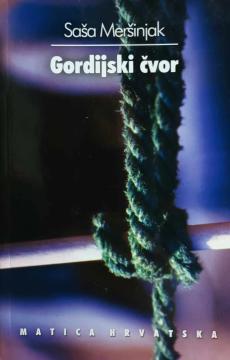
Gordijski čvor

Gordijski čvor

Saša Meršinjak

Most of the stories in this collection were published in Vijenec in the period from 1996-1998. years.

Saša Meršinjak was born on September 19, 1949 in Niš. He is a poet and a prose writer. He studied at the Faculty of Philosophy in Zagreb. He works as a freelance artist; writes essays, newspaper articles, film and art reviews. He edited Polet and Studentski list, and is the host of the Zagreb forum Jutro poezije. As a storyteller, he belongs to the generation of Croatian fantasy artists who appeared at the turn of the 1960s and 1970s. A frequent motif of his stories is the relationship between politics and every form of government, as a totalitarian system, towards the individual. He writes newspaper stories, and in his poetry he relies on Northern neofuturism.

Editor
Jelena Hekman
Illustrations
Luka Gusić
Graphics design
Luka Gusić
Dimensions
20 x 13 cm
Pages
159
Publisher
Matica hrvatska, Zagreb, 2002.
 
Latin alphabet. Paperback.
Language: Croatian.
ISBN
9-53-150655-8

No copies available

The last copy was sold recently.
 

Are you interested in another book? You can search the offer using our search engine or browse books by category.

You may also be interested in these titles

Mama Leone

Mama Leone

Miljenko Jergović

Jergović's stories ironically depict a childhood and an upbringing. The only reality of this autobiographical prose is moving from place to place and from country to country. Strength and beauty are found in the subtle threads with which he weaves his ima

Durieux, 1999.
Croatian. Latin alphabet. Paperback.
8.56
Priče o braku i seksu

Priče o braku i seksu

Michal Viewegh

The book contains about twenty stories connected into one whole by the main character (the writer Oskar). It is, therefore, a kind of novel that, through intimate confessions, actually talks about the loneliness of the modern intellectual.

DiVič, 1999.
Croatian. Latin alphabet. Hardcover.
7.46
Sikamora

Sikamora

Goran Samardžić

"Sikamura" is a collection that does not offer clear answers, but rather encourages the reader to interpret and reflect, making it demanding but significant in the context of contemporary literature.

Bosanska knjiga, 1997.
Croatian. Latin alphabet. Paperback.
5.984.19
Devojka i golubovi

Devojka i golubovi

Jaroslaw Iwaszkiewicz

Young Edek lives with his elderly father who tries to keep his son by his side. The boy's longing for freedom and a girl clashes with his father's possessiveness. The pigeons symbolize unattainable freedom. The conflict leads to a tragic ending.

Svjetlost, 1965.
Serbian. Latin alphabet. Paperback.
2.14
Gle krasne li paprati

Gle krasne li paprati

Branko Belan

The book "Look How Beautiful the Ferns" by Branko Belan is a collection of short stories set in the Mediterranean milieu, which is characteristic of Belan's literary work.

Alfa, 1978.
Croatian. Latin alphabet. Paperback.
13.26
Antologija poljske pripovijetke XX stoljeća

Antologija poljske pripovijetke XX stoljeća

Zdravko Malić

The anthology, edited and translated by Zdravko Malić, a leading Croatian Polish scholar and founder of the Polish Language Department at the Faculty of Fine Arts in Zagreb, represents a key selection of Polish short fiction from the 20th century.

Veselin Masleša, 1984.
Croatian. Latin alphabet. Hardcover with dust jacket.
7.24