Povijest kontarevolucije

Povijest kontarevolucije

Stipe Kljaić

Croatian conservative thought from 1789 to 1989.

Two hundred years of Croatian history, from the French Revolution in 1789 to the fall of the Berlin Wall in 1989, was mostly written and interpreted from the perspective of the so-called progressivist ideas and positions, which means that the space for research and reflection on Croatian conservatism was either very narrow or completely blocked by liberal-communist propaganda about conservative thought as something retrograde and backward.

Historian Stipe Kljaić (Šibenik, 1982), author of the bestseller Never Again Yugoslavia, chose 12 paradigmatic, mostly forgotten conservative thinkers (and fighters) from Croatian history for this book - Povijest cotrarevolucije / Croatian conservative thought from 1789 to 1989. who believed that everything new is not and does not have to be better than what was before, and that old, proven values are the only sure foundation for new social construction. The group of twelve is led by the champion of Croatian conservative thought, friar from Brač, counter-revolutionary Andrija Dorotić, philosopher, politician, police chief, benefactor, who launched an armed uprising against the French in Dalmatia, and is also composed of: Mihovil Pavlinović, Kosto Vojnović, Josip Juraj Strossmayer, Đuro Arnold, Stjepan Zimmermann, Dominik Barač, Milivoj Magdić, Hijacint Bošković, Bonifacije Perović, Bogdan Radica and Franjo Tuđman.

Editor
Josip Pavičić
Dimensions
20 x 14 cm
Pages
376
Publisher
Naklada Pavičić, Zagreb, 2021.
 
Latin alphabet. Paperback.
Language: Croatian.
ISBN
978-9-53794-921-1

One copy is available

Condition:Unused
Specificity of this instance:
Author signature
Dedication
Damages or inconvenience notice:
  • A message of a personal nature
 

Are you interested in another book? You can search the offer using our search engine or browse books by category.

You may also be interested in these titles

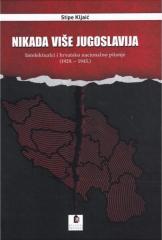
Nikada više Jugoslavija - Intelektualci i hrvatsko nacionalno pitanje (1929. - 1945.)

Nikada više Jugoslavija - Intelektualci i hrvatsko nacionalno pitanje (1929. - 1945.)

Stipe Kljaić

This book was created on the basis of a doctoral dissertation entitled "Intellectuals and Croatian Nationalism (1929 - 1945)."

Hrvatski institut za povijest, 2017.
Croatian. Latin alphabet. Hardcover.
21.98
Hrvatski narodni vladari od god. 620.–1102.

Hrvatski narodni vladari od god. 620.–1102.

Mate Sagher

A pioneering attempt at a systematic presentation of Croatian political history from the settlement of Croats to the conclusion of a personal union with Hungary. Segher chronologically traces the development of Croatian statehood, relying on the sources a

Dionička tiskara, 1903.
Croatian. Latin alphabet. Paperback.
14.76
Komunizam i čovjek: Odnos vlasti i pojedinca u Hrvatskoj (1958.–1972.)

Komunizam i čovjek: Odnos vlasti i pojedinca u Hrvatskoj (1958.–1972.)

Josip Mihaljević

Josip Mihaljević's book analyzes the relationship between the government and the individual in communist Croatia (1958–1972), through repressive mechanisms, ideological pressures, and restrictions on personal freedom in the socialist system.

Hrvatski institut za povijest, 2016.
Croatian. Latin alphabet. Hardcover.
17.26
Hrvatska: Domovina Marka Pola

Hrvatska: Domovina Marka Pola

This tourist brochure reminds us of Marco Polo and the historical context within which he operated.

Hrvatska turistička zajednica, 2008.
Croatian. Latin alphabet. Paperback.
3.98
Osječka groblja

Osječka groblja

Stjepan Sršan

The book is deeply rooted in the local history and culture of Osijek, with an emphasis on cemetery motifs that serve as a metaphor for memory, death, and disappearance.

Povijesni arhiv u Osijeku, 1996.
Croatian. Latin alphabet. Paperback.
5.26
Vodič kroz grad Osijek

Vodič kroz grad Osijek

An important document reflecting the state of the city immediately after World War II. The guide served as a practical tool for orientation and informing citizens and visitors about the urban layout and infrastructure of the city at that time.

Gradski N. O., Građevinski odjel u Osijeku, 1946.
Croatian. Latin alphabet. Paperback.
64.28