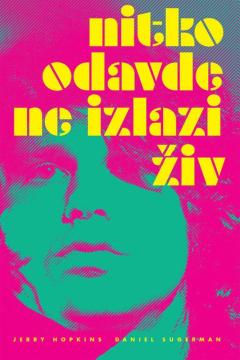
Nitko odavde ne izlazi živ

Nitko odavde ne izlazi živ

Jerry Hopkins, Daniel Sugerman

The cult biography of The Doors' singer Jim Morrison, No One Here Gets Out Alive, written in the spirit of the era, without a hair on the tongue, is a must-read for all admirers of this true great of rock music.

Jim Morrison was a man who neither wanted nor could agree to compromises, a man who refused them, either in relation to himself or his art. And therein lies his innocence and purity – his simultaneous blessing and curse. Go all the way or die trying. All or nothing. Ecstatic risk. He did not want to create ready-made goods or lower the price of what he wrote, he could not feign despair or simulate ecstasy. He didn't just want to entertain or “work out; he was brilliant and desperate, motivated by a constant need to test the limits of reality", questioning the sacred, exploring the profane. And that's why he was crazy... crazy about creativity, crazy about authenticity. But because of the same traits, he became unstable, dangerous and conflicted with himself. He sought solace and relief in the same elements that initially inspired him and helped him create: opiates.

Jim Morrison's poems reflect the influence of William Blake, Charles Baudelaire, Arthur Rimbaud and Friedrich Nietzsche. Remembered for his theatrical, Dionysian, provocative and even obscene stage performances - there were often more policemen on stage than band members - Morrison looked for inspiration in the work of the French playwright Antonin Artaud and in the shamanism of American Indians. Genuinely interested in mythology, mysticism and symbolism, he read Frazer's The Golden Bough, and the name of the group The Doors, of which he was the singer, was derived from the title of Aldous Huxley's essay, The Doors of Perception. Trying to get through them himself, he did not hesitate to consume huge amounts of alcohol and hallucinogenic drugs, so that in the end he succeeded: he broke through to the "other side" as a twenty-seven-year-old (The gate is straight / Deep and wide / Break on through to the other side...). He was buried in Paris, at the Pere-Lachaise cemetery, and his company includes Marcel Proust, Frederic Chopin, Oscar Wilde, Édith Piaf...

Original title
No One Here Gets Out Alive
Translation
Karmela Cindrić
Editor
Darko Milošić
Graphics design
Nikša Eršek
Dimensions
23.5 x 16 cm
Pages
327
Publisher
Sandorf, Zagreb, 2020.
 
Latin alphabet. Paperback.
Language: Croatian.
ISBN
978-9-53351-205-1

No copies available

The last copy was sold recently.
 

Are you interested in another book? You can search the offer using our search engine or browse books by category.

You may also be interested in these titles

Rudžer Bošković: Građa, knjiga I

Rudžer Bošković: Građa, knjiga I

Mirko Deanović, Josip Torbarina, Branimir Truhelka

The collection of works on Ruđer Bošković includes his letters, literary connections with the English, and biographical and scientific contributions. It is an important source for studying the life and work of the great scientist.

Jugoslavenska akademija znanosti i umjetnosti (JAZU), 1950.
Croatian. Latin alphabet. Hardcover.
16.74
Mladi Tesla: Djetinjstvo slavnog naučenjaka

Mladi Tesla: Djetinjstvo slavnog naučenjaka

Milenko Karanović

Young Tesla is a picture book and biographical work for young readers that depicts Nikola Tesla's childhood, his curiosity, first inventions, and the path to becoming a scientific genius who would mark world history.

Jugoreklam, 1977.
Croatian. Latin alphabet. Hardcover.
14.46
Franjo Ž. Kuhač: Stari Osijek i Zagreb

Franjo Ž. Kuhač: Stari Osijek i Zagreb

Antonija Kassowitz-Cvijić

A biographical portrait of Franjo Ž. Kuhač depicting his life and work in old Osijek and Zagreb, published in 1924 on the occasion of the 90th anniversary of Kuhač's birth.

Matica hrvatska, 1924.
Croatian. Latin alphabet. Paperback.
9.36
Hrvatski Job šesnaestoga vijeka – život i djela Ivana Karlovića

Hrvatski Job šesnaestoga vijeka – život i djela Ivana Karlovića

Petar Grgec

Petar Grgec depicts the life of Ban Ivan Karlović (Kurjaković), known as the "Croatian Job" for his suffering in the battles against the Turks. A popular historical monograph published by the Croatian Academy of Sciences of St. Jerome.

Hrvatsko književno društvo Sv. Jeronima, 1932.
Croatian. Latin alphabet. Paperback.
12.42
Vatroslav Lisinski i njegovo doba: Prilog za poviest hrvatskoga preporoda

Vatroslav Lisinski i njegovo doba: Prilog za poviest hrvatskoga preporoda

Franjo Ksaver Kuhač

A fundamental monograph on Vatroslav Lisinski presents the life and work of the first Croatian opera composer, as well as the cultural, political and musical circumstances of the Illyrian period. With a portrait of Vatroslav Lisinski.

Matica hrvatska, 1904.
Croatian. Latin alphabet. Hardcover.
5.32
Velik je misterij života: dnevnik 1917.-1934.

Velik je misterij života: dnevnik 1917.-1934.

Lucija Bakšić, Magdalena Blažić

The diary of Marija Vinski, written from 1917 to 1934, tells the extensive life story of an intellectual doctor about her struggle to find her own place in the sun.

Disput, 2021.
Croatian. Latin alphabet. Hardcover.
20.85