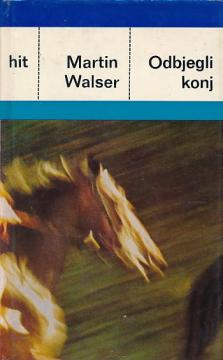
Odbjegli konj

Odbjegli konj

Martin Walser

Martin Walser's Runaway Horse is a psychological novel about two middle-aged men whose chance meeting during a vacation raises questions about aging, success, marriage, and the meaning of life.

The Runaway Horse is one of the most famous works by the German writer Martin Walser. The novel takes place during a summer vacation on Lake Constance, where old school friends Helmut Halm and Klaus Buch meet.

Helmut is a reclusive high school teacher who has been spending his vacation in the same place with his wife Sabine for years. He lives a quiet and predictable life, avoids company and does not like change. His routine is interrupted by the sudden arrival of Klaus Buch, a former schoolmate. Klaus is the complete opposite of Helmut – energetic, self-confident and constantly eager for new challenges. He is accompanied by his younger partner Helene, whose openness further emphasizes the difference between the two couples.

Klaus organizes sailing trips, excursions and various adventures, trying to get Helmut out of his isolation. Although Helmut resists at first, he gradually becomes fascinated but also disturbed by Klaus's way of life. Their friendship develops into a kind of competition in which each of them begins to question their own life choices.

As the plot progresses, it becomes clear that Klaus's security is not what it seems. Behind his need for constant activity lie insecurity and fear of aging. At the same time, Helmut realizes that his peaceful life is not the result of pleasure but often escape from risk and change. Their wives also play an important role, whose reactions reveal the weaknesses of both men.

The title of the novel is connected with the scene in which a scared horse runs away from its owners. This motif symbolizes man's desire to escape from limitations, routine, and transience. Through a simple plot, Walser creates a precise psychological study of the midlife crisis, facing one's own failures, and the fear of a passing life.

Original title
Eine fliehendes Pferd
Translation
Mignon Mihaljević
Editor
Zlatko Crnković
Graphics design
Alfred Pal
Dimensions
19 x 12 cm
Pages
111
Publisher
Znanje, Zagreb, 1983.
 
Latin alphabet. Hardcover with dust jacket.
Language: Croatian.

One copy is available

Condition:Used, excellent condition
 

Are you interested in another book? You can search the offer using our search engine or browse books by category.

You may also be interested in these titles

Amandino vjenčanje

Amandino vjenčanje

Jenny Colgan

A romantic comedy about friendship, love, and the chaotic attempts to save a good man from a bad marriage. A chick-lit hit, it reminds us that friendship saves more than any plan, and love comes unexpectedly.

Znanje, 2001.
Croatian. Latin alphabet. Paperback.
5.36
Zajednička kupka

Zajednička kupka

Ranko Marinković

The communal bath is a kind of recapitulation - in it, Marinković's obsessive motives (humiliation, fraud and death) are discussed in the most direct and immediate way. In one of its layers, the novel is also a metaphor for literature, an allegory about t

Znanje, 1980.
Croatian. Latin alphabet. Hardcover with dust jacket.
8.56
Večernji akt

Večernji akt

Pavao Pavličić

The story, centered on the brilliant forger Mihovil, criticizes the literature and art of our time. It also reflects on a society that is ready to adapt the coordinates of history to its own needs.

Znanje, 1981.
Croatian. Latin alphabet. Hardcover with dust jacket.
3.98
Graditelj svratišta

Graditelj svratišta

Ivan Aralica

The inn builder is a realistic historical novel, in the tradition of Andrić, but with elements of fantasy that connect Aralica with the oral Croatian literary word, but also with the fantastic literature of Gabriel García Marques, for example.

Znanje, 1987.
Croatian. Latin alphabet. Hardcover with dust jacket.
7.26
Slobodni pad

Slobodni pad

Pavao Pavličić

Pavličić's novel deals with the psychological and ethical consequences of human choices in extreme circumstances. It is not just a novel about a man in crisis, but also a study of how a person reacts when they lose their support - in themselves, in others

Znanje, 1982.
Croatian. Latin alphabet. Hardcover with dust jacket.
6.46
Put u Jajce

Put u Jajce

Edvard Kocbek

In Put u Jajce, Edvard Kocbek provides personal and political testimony about key moments in Yugoslav history. The book is based on Kocbek's memories from the Second World War, especially the trip to Jajce in 1943.

Znanje, 1978.
Croatian. Latin alphabet. Hardcover with dust jacket.
8.38