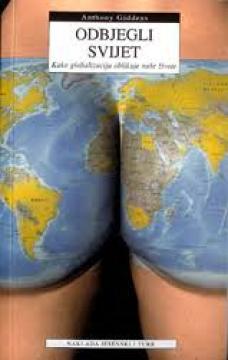
Odbjegli svijet : Kako globalizacija oblikuje naše živote

Odbjegli svijet : Kako globalizacija oblikuje naše živote

Anthony Giddens

This book contains lectures by sociologist Anthony Giddens on the state of the world at the end of the twentieth century. Globalization, risk, tradition, family and democracy are key and unavoidable topics in understanding the state and changes of the mod

The book by the leading British and world sociologist Anthony Giddens deals with the most important aspects and consequences of globalization. Both for nations - states, societies, transnational social formations and political systems, as well as for individuals, families and everyday life.

Borrowing the title of a lecture by anthropologist Edmund Leach from the 1970s, the author refers to a fact that we feel more and more today - namely, the world around us is changing and transforming at a speed that leaves doubts and disorientation... In this popular-scientific introduction to globalization, the author lists all relevant aspects. From economic transnationalization to general risks, identity transformation, various forms of fundamentalism to the restructuring of democratic systems, Giddens covers all the areas in which the expression of globalization is strongest.

Original title
Runaway world
Translation
Ana Milićević
Editor
Tanja Vučković
Dimensions
18 x 12 cm
Pages
107
Publisher
Jesenski i Turk, Zagreb, 2005.
 
Latin alphabet. Paperback.
Language: Croatian.
ISBN
978-9-53222-194-7

One copy is available

Condition:Unused
 

Are you interested in another book? You can search the offer using our search engine or browse books by category.

You may also be interested in these titles

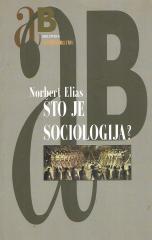
Što je sociologija?

Što je sociologija?

Norbert Elias

A classic work by one of the most influential sociologists of the 20th century, the founder of "figurative" or "process" sociology. The book is a programmatic manifesto against the then dominant structural-functionalist paradigm (Parsons) and pure positiv

Antibarbarus, 2007.
Croatian. Latin alphabet. Paperback.
8.26
Titostalgija

Titostalgija

Mitja Velikonja

The author explores why Tito remains a popular symbol of stability, social security and independence, despite critical views of his regime. The book maps the cultural, political and everyday manifestations of "Titostalgia".

Biblioteka XX vek, 2010.
Serbian. Latin alphabet. Paperback.
7.36
Uspon autoritarizma na Zapadnom Balkanu

Uspon autoritarizma na Zapadnom Balkanu

Florian Bieber

The book describes how the Western Balkans, after initial democratic hopes in the 2000s, slipped into competitive authoritarianism. It explains the mechanisms of "strongman" rule, the role of EU stabilocracy and why democracy does not consolidate.

Profil Knjiga, 2022.
Croatian. Latin alphabet. Paperback.
8.24
Umiruće tijelo politike: Rat - konstitucija nacionalnog tijela

Umiruće tijelo politike: Rat - konstitucija nacionalnog tijela

Senadin Musabegović

The philosophical and theoretical study by a Bosnian-Herzegovinian author analyzes how the war in Bosnia and Herzegovina from 1992 to 1995 was a biopolitical project of creating a "pure" national body through the systematic killing, expulsion, and rape of

Buybook, 2019.
Croatian. Latin alphabet. Paperback.
11.24
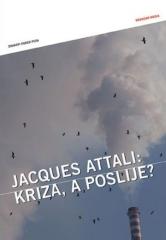
Kriza, a poslije?

Kriza, a poslije?

Jacques Attali

After A Brief History of the Future, Jacques Attali writes a brief history of the present, dissecting the reasons that led to the first global financial crisis, the ways in which it manifests itself, and possible perspectives for the future.

MeandarMedia, 2009.
Croatian. Latin alphabet. Paperback.
9.24
Sve što je čvrsto i postojano pretvara se u dim...

Sve što je čvrsto i postojano pretvara se u dim...

Katarina Peović-Vuković

Katarina Peović's collection of texts revives Marxism in the era of capitalist crisis. The book analyzes key works by Marx and Engels, connecting them with contemporary thinkers such as Alain Badiou and Michael Lebowitz.

Durieux, 2021.
Croatian. Latin alphabet. Paperback.
16.52