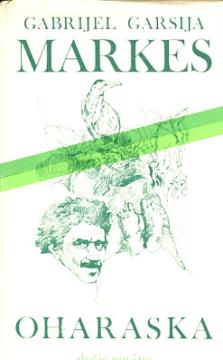
Oharaska

Oharaska

Gabriel Garcia Marquez

Gabriel Garcia Marquez began writing Oharaska when he was 19, although it was published eight years later.

Oharaska is an embryonic work, a promise of what Marquez will continue in literature, but full of drama, colorful and historical events, which will serve as a thread for his other works. Marquez was captured by Oharaska like no later work. It came out of him disconnected and without literary intentions, but as he says, it was written with the most genuine inspiration. Oharaska shows the residue of hatred, disconnection between people and ill will left in the mythical village of Makondu by the passing of the banana company, which was stationed there for many years.

Original title
La hojarasca
Translation
Jasna Mimica Popović
Editor
Milomir Glišić
Graphics design
Momčilo Antonijević
Dimensions
22 x 13 cm
Pages
107
Publisher
Dečje novine, Gornji Milanovac, 1978.
 
Distribution: 5,000 copies
 
Latin alphabet. Hardcover with dust jacket.
Language: Serbian.

No copies available

The last copy was sold recently.
 

Are you interested in another book? You can search the offer using our search engine or browse books by category.

You may also be interested in these titles

Neverovatna i tužna istorija nevine Erndire i njene bezdušne babe: sedam priča

Neverovatna i tužna istorija nevine Erndire i njene bezdušne babe: sedam priča

Gabriel Garcia Marquez
Dečje novine, 1979.
Croatian. Latin alphabet. Paperback.
2.99
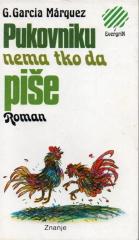
Pukovniku nema tko da piše

Pukovniku nema tko da piše

Gabriel Garcia Marquez

The Colonel Has No One to Write to by Gabriel García Márquez is a story about an old colonel who has been waiting for years for his promised state pension. In poverty and uncertainty, he refuses to lose hope.

Znanje, 1982.
Croatian. Latin alphabet. Paperback.
4.86
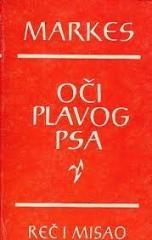
Oči plavog psa

Oči plavog psa

Gabriel Garcia Marquez
Izdavačko preduzeće "Rad", 1979.
Serbian. Latin alphabet. Paperback.
3.98
Deobe

Deobe

Dobrica Ćosić

Deobe is a novel about the tragic division of Serbs into Chetniks and Partisans during World War II. Winner of the NIN Award, it is part of a wider epic trilogy, inspired by Ćosić's experiences and historical documents.

Prosveta, 1963.
Croatian. Latin alphabet. Hardcover with dust jacket.
13.74
Tri mušketira 1-2

Tri mušketira 1-2

Alexandre Dumas

Dumas' version of the story depicts the adventures of d'Artagnan and his friends from 1625 to 1628.

Epoha, 1966.
Croatian. Latin alphabet. Hardcover with dust jacket.
The book consists of two volumes
9.48
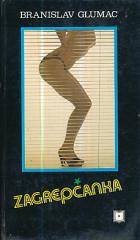
Zagrepčanka

Zagrepčanka

Branislav Glumac

Branislav Glumac published a novel without periods or commas in 1974, as the relentless stream of thought of a young rebel. Published in socialist Yugoslavia, the work caused a scandal with its openness and became a classic about generational rebellion.

IROS, 1986.
Croatian. Latin alphabet. Hardcover.
8.24