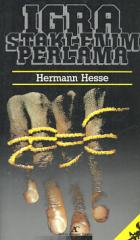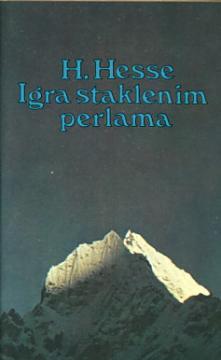
Igra staklenim perlama

Igra staklenim perlama

Hermann Hesse

A philosophical novel set in a fictional future, in the province of Kastalia, where the intellectual elite cultivate a spiritual discipline known as the Glass Bead Game. The novel follows the life of Joseph Knecht, who goes from student to Magister Ludi,

Knecht's journey reflects the inner struggle between spiritual life and worldly responsibilities. Castalia, isolated from the world, preserves knowledge, but is separated from reality. Knecht begins to doubt the purpose of the Game, realizing its lack of influence on the world outside of Castalia. He eventually leaves his position, wanting to apply his knowledge in the real world as a teacher to a young student. The novel ends tragically but symbolically, leaving the question of the balance between spirit and everyday life.

Hese explores themes of intellectual discipline, spirituality, individualism, and the conflict between idealism and practicality. The novel criticizes the separation of the elite from society and questions the purpose of knowledge without action. Throughout Knecht's life, Hesse raises questions about the meaning of art and culture in times of crisis. The work is deeply meditative, rich in symbolism and philosophical depth, which makes it a masterpiece of world literature.

Original title
Das glasperlenspiel
Translation
Vera Čičin Šain
Editor
Vera Čičin Šain, Milan Mirić
Graphics design
Alfred Pal
Dimensions
21 x 12.5 cm
Pages
497
Publisher
Sveučilišna naklada Liber (SNL), Zagreb, 1979.
 
Latin alphabet. Hardcover with dust jacket.
Language: Croatian.

One copy is available

Condition:Used, excellent condition
 

Are you interested in another book? You can search the offer using our search engine or browse books by category.

You may also be interested in these titles

Igra staklenim perlama

Igra staklenim perlama

Hermann Hesse

The novel "The Glass Bead Game", published in 1943, is Hermann Hesse's greatest, almost life-long work, which he wrote for almost 12 years.

August Cesarec, 1987.
Croatian. Latin alphabet. Paperback.
8.32
Narziß und Goldmund

Narziß und Goldmund

Hermann Hesse

In the novel Narcissus and Chrysostom, Hermann Hesse follows two friends: the ascetic monk Narcissus and the artistically restless Chrysostom, who search for the meaning of life through wanderings, love, and suffering.

Suhrkamp Verlag, 1971.
German. Latin alphabet. Hardcover with dust jacket.
7.42
Crni Napoleon

Crni Napoleon

Karl Otten

The Black Napoleon (1931) is a fictional biography of Toussaint Louverture. It depicts the Haitian Revolution (1791–1803), the slave uprising in Saint-Domingue, Louverture's brilliant military and political rise, and his struggle against the colonial powe

Nakladni zavod Ante Velzek, 1940.
Croatian. Latin alphabet. Hardcover with dust jacket.
6.32 - 14.56
Poezija i zbilja

Poezija i zbilja

Johann Wolfgang Goethe

Goethe's greatest autobiographical prose, written between 1811 and 1833, covers his life from his birth in 1749 in Frankfurt to 1775, when he went to Weimar at the invitation of Duke Karl August.

Matica hrvatska, 1953.
Croatian. Latin alphabet. Hardcover with dust jacket.
18.42
Budenbrokovi

Budenbrokovi

Thomas Mann

The Buddenbrooks is not just a family chronicle – it is a profound, melancholic fresco of how time and change inexorably creep into the core of a respectable bourgeois family, bringing with them a downfall that is both tragic and inevitable.

Svjetlost, 1961.
Serbian. Latin alphabet. Hardcover.
The book consists of two volumes
11.54
Josip i njegova braća III: Josip u Egiptu

Josip i njegova braća III: Josip u Egiptu

Thomas Mann

The third part of the tetralogy by German Nobel Prize winner Thomas Mann, Joseph and His Brothers, is entitled Joseph in Egypt. This tetralogy is considered one of the most important works by Thomas Mann, as well as by German literature of the twentieth c

Fraktura, 2010.
Croatian. Latin alphabet. Hardcover with dust jacket.
34.62