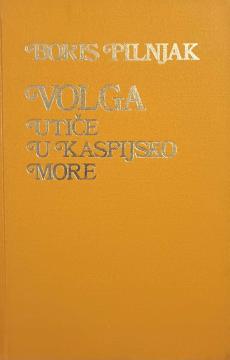
Volga utiče u Kaspijsko more
Rare book

Volga utiče u Kaspijsko more

Boris Piljnjak

In the center of the novel Volga Flows into the Caspian Sea, an old Russian province is caught in the majestic act of the river flowing.

Through the image of the construction of a twenty-five meter high stone embankment, in which a large number of peasants and citizens who are desperately clinging to the edges of the disappearing world participate, the writer vividly shows us the stubborn resistance and condemnation of the individual to failure in the fight against the collective, leaving evident the nostalgic attachment to old Russia . It is a type of report written by a great storyteller about the political and family life of two Russias - the one that is disappearing and the one that is ruling. The repression of the authorities in the Soviet Union was aimed at extracting and erasing the roots of the past, the feeling that connected the entire nation. In this tension and cultural split, the immortality of the soul of the thousand-year-old great Russia was discernible. The restlessness characteristic of Piljnjak's expressiveness, a knot of densely interwoven obsessions, fears and insecurities, and feelings of powerlessness, which appear especially in the nocturnal reflections of his characters, runs through this work. The dramatic tension of the novel is reflected in the proclaimed will and policy of the rulers for the progress of Russia, which collides with the stubborn resistance of the characters attached to tradition, who do not want to enter the new promised world, knowing that it will tear them away from everything that had determined their way of life until then and identity. The cry of the helpless peasants hits the stone blocks of the huge embankment and disappears into the depths of the river.

Translation
Dimitrije Đurović
Editor
Milorad Najdanović
Dimensions
20.5 x 13.5 cm
Pages
261
Publisher
Jugoslavijapublik, Beograd, 1980.
 
Latin alphabet. Hardcover.
Language: Croatian.

No copies available

The last copy was sold recently.
 

Are you interested in another book? You can search the offer using our search engine or browse books by category.

You may also be interested in these titles

Gola godina

Gola godina

Boris Piljnjak
Nolit, 1956.
Serbian. Latin alphabet. Hardcover with dust jacket.
8.42 - 8.46
Plavi bicikl

Plavi bicikl

Regine Deforges

The French publisher and writer Régine Deforges wrote a handful of novels, but it was not until The Blue Bicycle that she achieved incredible commercial success in France and in the world.

Znanje, 1987.
Croatian. Latin alphabet. Hardcover with dust jacket.
3.36 - 3.42
Najbolje što se može dogoditi jednom kroasanu

Najbolje što se može dogoditi jednom kroasanu

Pablo Tusset

What happens when Pablo Baloo Miralles, a lazy and maladjusted thirty-year-old pleasure hunter and famous philosopher of the Web, in search of his rich brother The First, becomes involved in a secret hidden in a seemingly peaceful neighborhood of Barcelon

Naklada MD, 2004.
Croatian. Latin alphabet. Paperback.
12.32
Put u Tolmin

Put u Tolmin

Ciril Kosmač

"The Road to Tolmin" is a novel by Slovenian author Ciril Kosmač that explores themes of identity, belonging, and internal conflicts.

Spektar, 1974.
Croatian. Latin alphabet. Hardcover.
2.62 - 2.64
Mati

Mati

Pearl S. Buck

"The Good Earth" is a novel written by Pearl S. Buck, an American writer who received the Nobel Prize for Literature in 1938. The novel was first published in 1931 and became one of her most famous works.

Naklada Binoza, 1938.
Croatian. Latin alphabet. Hardcover with dust jacket.
8.56 - 21.56
Fiškal / Među žabarima

Fiškal / Među žabarima

Ante Kovačić

"Fiškal" is a novel by Ante Kovačić, which deals with themes of identity, social change, and the conflict between tradition and modernity.

Mladost, 1978.
Croatian. Latin alphabet. Hardcover with dust jacket.
5.32