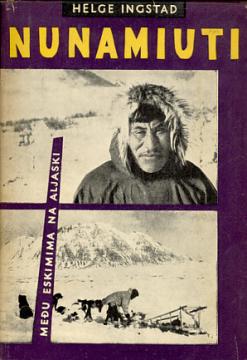
Nunamiuti: među eskimima na Aljaski

Nunamiuti: među eskimima na Aljaski

Helge Ingstad

Nunamiut - Eskimos (Labrador Algonquian: those who eat raw meat or, according to recent interpretations, those who knit snowshoes; they call themselves Inuit: people, singular Inuk), the population of the Arctic region.

They live in a large area from Greenland and Labrador in the east to the Bering Sea and Siberian coasts in the west and on some arctic islands (Victoria Island, Baffin Island). They used to live in the interior of North America, but the Indians (Athapaski) pushed them to the north. Eskimos are mongoloids, tawny skin, short stature. They speak the languages ​​of the Eskimo branch of the Eskimo-Aleut languages.

Traditionally, coastal Eskimos were fishermen and hunters of seals, walruses, whales, and inland hunters of reindeer, bears and musk oxen. Towards the end of the XIX century they began to breed reindeer in Alaska, and from 1930 in Canada as well. Their fur clothing and overall equipment (harpoon, dog sled, kayak, windbreaker with hood - anorak, hut made of ice blocks - igloo, etc.) are perfectly adapted to the polar region. Fine art is predominantly miniature (carvings made of walrus bone); wood and bone carving was developed in Alaska and Greenland, and today in Canada, stone sculpture is also developed.

They live in kinship groups. The main person in the community is the shaman, who is considered a mediator between the world of spirits, nature and people. The Eskimos have many myths; they believe in the afterlife and the underworld. Despite today's acquisition of modern civilizational achievements, approximately 150,000 Eskimos strive to preserve their ethnic identity.

Original title
Nunamiut - Inlands eskimoer blant Alaskas
Translation
Srećko Šilović
Dimensions
22 x 16 cm
Pages
207
Publisher
SKD Prosvjeta, Zagreb, 1957.
 
Distribution: 3,000 copies
 
Latin alphabet. Hardcover with dust jacket.
Language: Croatian.

One copy is available

Condition:Used, excellent condition
Damages or inconvenience notice:
  • Slight damage to the dust jacket
 

Are you interested in another book? You can search the offer using our search engine or browse books by category.

You may also be interested in these titles

Pretapanja: Pannonius-Vrančić

Pretapanja: Pannonius-Vrančić

Helena Sablić Tomić

The book explores how different cultures and traditions intertwine and influence each other throughout history. Also, the book touches on the topics of identity, migration and transformation of societies.

Oksimoron, 2010.
Croatian. Latin alphabet. Hardcover.
14.62
Dva svijeta i još jedan

Dva svijeta i još jedan

Tomica Bajsić

Prose about time travel – a book about the sea, the river and the lake. The sea is the ocean of R.L. Stevenson, Daniel Defoe, Captain Frederic Marryat and today's adventurers, the river is the January River (Rio de Janeiro), and the lake is Parima, where

Naklada Ljevak, 2007.
Croatian. Latin alphabet. Paperback.
9.98
Pisma iz progonstva / Zimske beleške o letnjim utiscima / Krotka

Pisma iz progonstva / Zimske beleške o letnjim utiscima / Krotka

Fjodor Mihajlovič Dostojevski

Fyodor Dostoevsky, one of the greatest writers and visionaries in history, is presented in this edition with a selection from his correspondence (Letters from Exile), an account of his first trip to Europe (Winter Notes on Summer Impressions), and the fam

LOM, 2012.
Serbian. Cyrillic alphabet. Paperback.
6.745.06
Fenomen Južne Koreje

Fenomen Južne Koreje

Miloje Popović

The book "The Phenomenon of South Korea" provides insight into various aspects of Korean society, culture, politics and economy.

Književne novine, 1990.
Serbian. Latin alphabet. Paperback.
4.68
Širom svijeta - Čovjek osvaja pustinju

Širom svijeta - Čovjek osvaja pustinju

Barbara Starčević
Školska knjiga, 1962.
Croatian. Latin alphabet. Paperback.
4.98
Naši ljudi i krajevi: Pejzaži, novele, crtice

Naši ljudi i krajevi: Pejzaži, novele, crtice

Antun Gustav Matoš, Fran Mažuranić

"Our People and Regions" is a collection of essays and travelogues by A. G. Matoš from 1910. The collection provides a deep insight into the Croatian regions and people of the early 20th century, reflecting Matoš's love for his homeland and his ability to

Spektar, 1974.
Croatian. Latin alphabet. Hardcover.
6.24